Ubunye Engine: One Framework, One Convention, One CLI. Why Unity Is the Real Deliverable
A Technical Memoir
This is not a polished tutorial. This is the real story: the broken imports, the silent CI failures at 2am, the bug that lived inside a single-line fallback, and the slow accumulation of something that actually works. If you've ever built a framework from scratch, you'll recognise every one of these moments.
The Idea#
Every data team eventually hits the same wall. You have notebooks that work locally. You have Spark jobs that work on the cluster. You have ML experiments scattered across a dozen different scripts, each trained differently, saved differently, versioned not at all. Moving anything to production means a week of archaeology, figuring out which version of which script produced which model, what data it saw, and why the schema looks different today than it did last Tuesday.
The idea behind Ubunye Engine was simple: one framework, config-first, that owns the full lifecycle from raw data ingestion through to versioned model deployment. Users write their business logic. The engine handles everything else: I/O, monitoring, lineage, model registry, CLI, documentation.
Simple idea. Complicated execution.
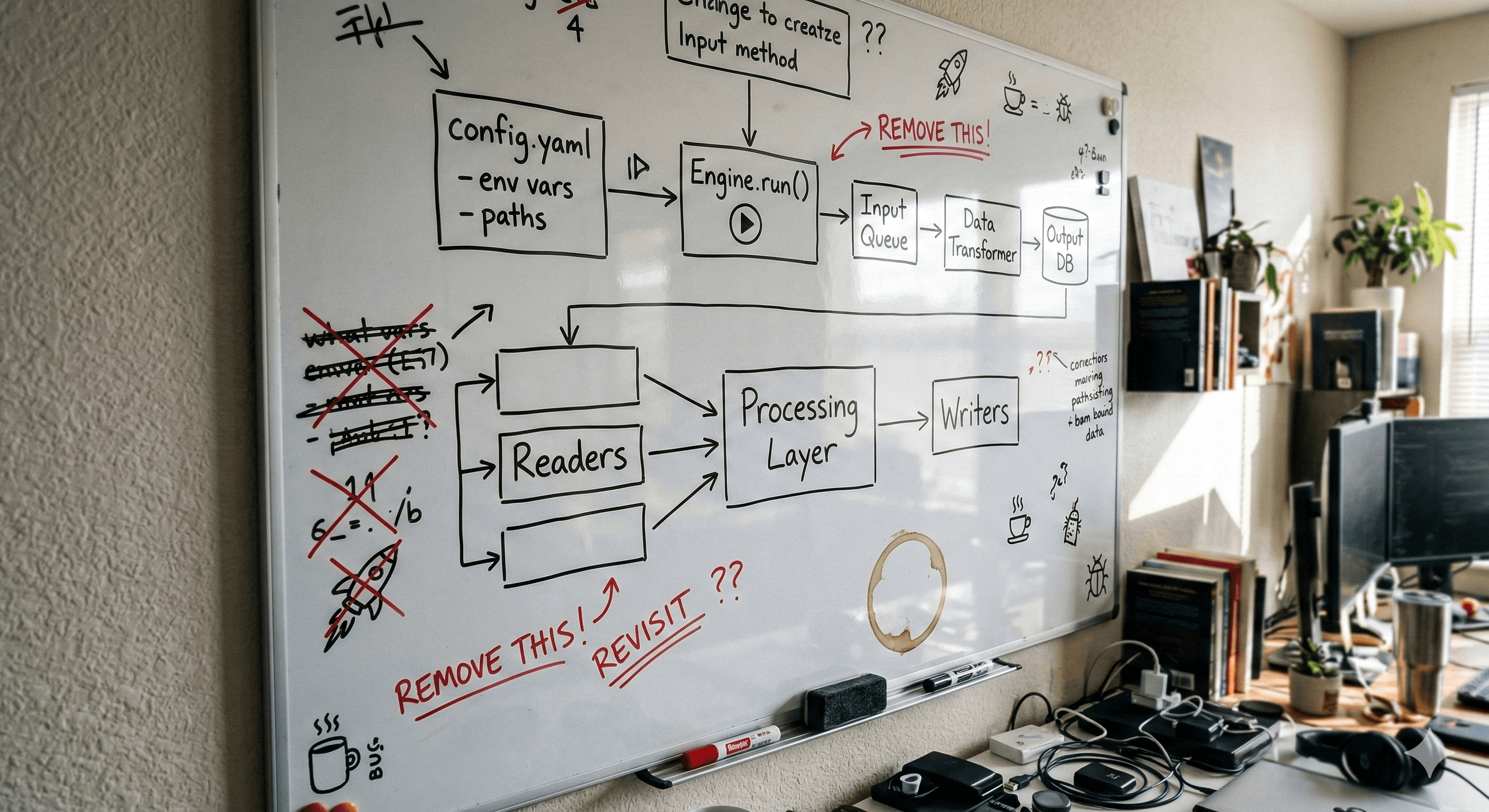
Phase 1-4: Building the Foundation (And Discovering What "Done" Means)#
The first four phases were about building the core contracts:
-
Phase 1, Config loading: YAML + Jinja2 rendering before Pydantic validation. The key insight was that
{{ dt | default('1970-01-01') }}needs to render before the schema sees it, not after. Getting that order right took longer than it should have. -
Phase 2, Lineage tracking: every run writes a structured JSON record (run ID, task path, input/output hashes, row counts, duration, status). Small files. Big value. When something breaks in production at 3am, the first question is always "what data did this run see?" The lineage file answers it without a Slack thread.
-
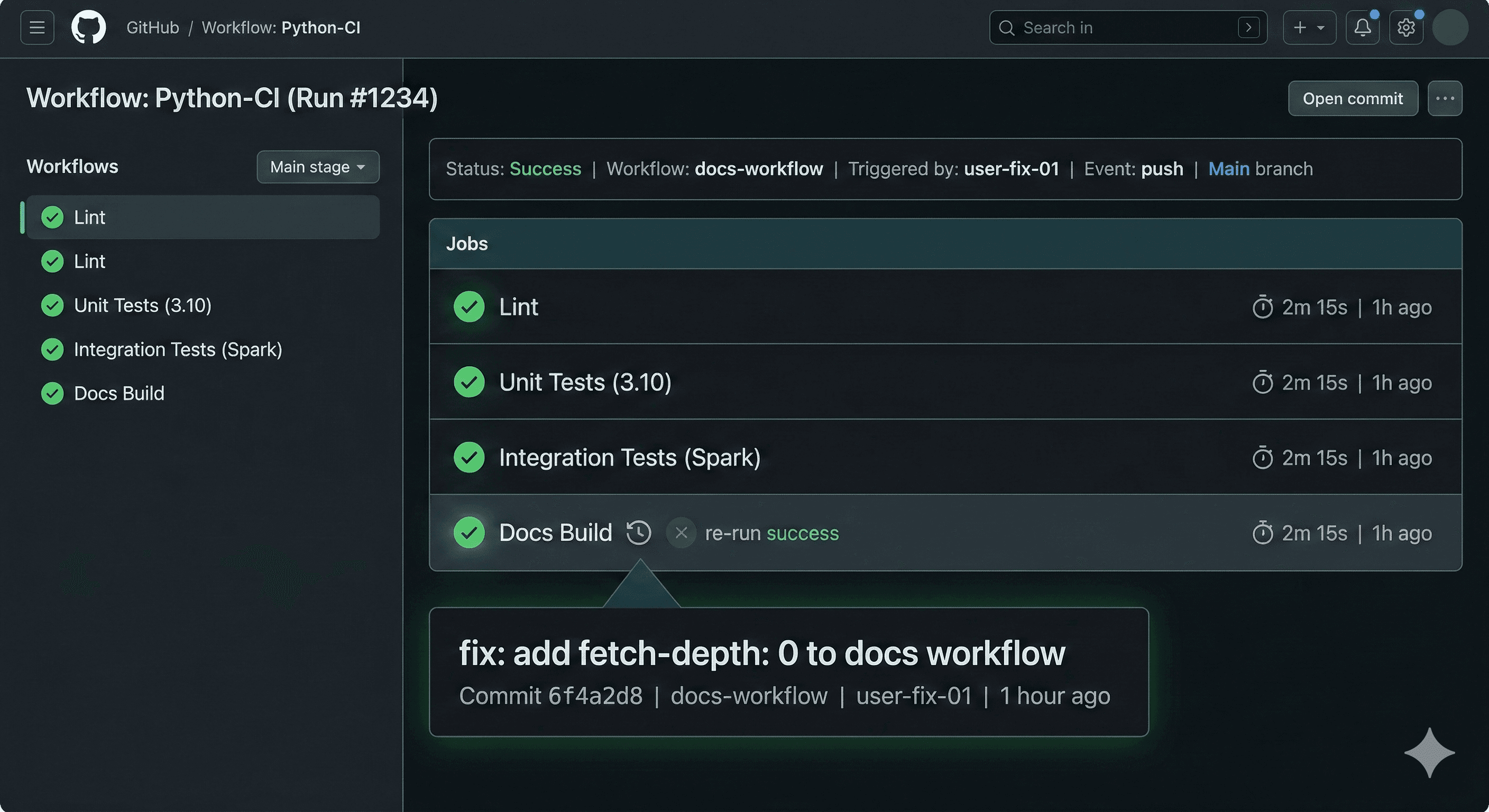
Phase 3, Test infrastructure: unit tests that run without Spark, integration tests that spin up a real local SparkSession. The matrix was Python 3.9, 3.10, 3.11 × unit
- integration. GitHub Actions.
pytest-cov,hypothesis,pytest-timeout. Standard stuff, except none of these were inpyproject.toml'sdevextras yet, which meant CI was failing silently withunrecognized arguments: --cov=ubunyefor weeks before anyone noticed.
- integration. GitHub Actions.
-
Phase 4, Access control: role-based config guards so not every pipeline can write to production targets. Not glamorous. Essential.
Each phase felt finished. None of them were.
 #
#
Phase 5: The Model Registry, The One That Changed Everything#
The model registry was where the project went from "interesting framework" to "something a team could actually use in production."
The design principle was strict: the engine must never import sklearn, PyTorch,
XGBoost, or any ML library. It interacts with models only through an abstract
contract, UbunyeModel, with four methods: train, predict, save, load.
The engine calls these. It doesn't care what's inside them.
class UbunyeModel(ABC):
    @abstractmethod
    def train(self, df: Any) -> Dict[str, Any]: ...

    @abstractmethod
    def predict(self, df: Any) -> Any: ...

    @abstractmethod
    def save(self, path: str) -> None: ...

    @classmethod
    @abstractmethod
    def load(cls, path: str) -> "UbunyeModel": ...
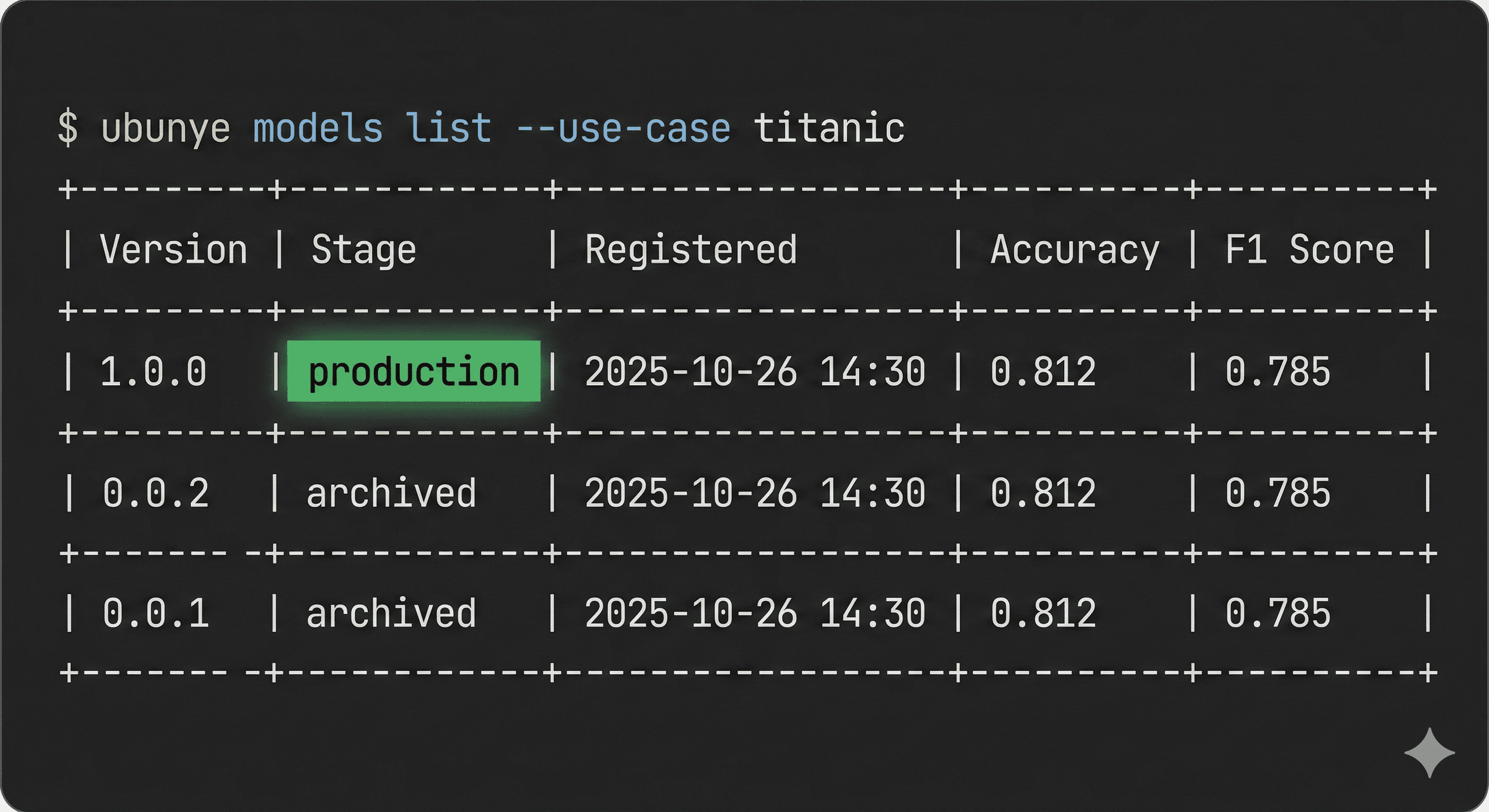
Simple. But getting the storage layout right, the version auto-increment, the
development → staging → production → archived lifecycle, and the promotion gates
took weeks of iteration.
The promotion gates were the most satisfying piece:
PromotionGate({
    "min_accuracy": 0.85,
    "min_f1":       0.80,
    "require_drift_check": True,
})
A model cannot advance to production unless every gate passes. If it fails, the error tells you exactly which metric missed and by how much. No more "I thought it was good enough" production deployments.
The filesystem storage layout ended up clean:
.ubunye/model_store/
  fraud_detection/
    FraudRiskModel/
      registry.json          ← all version metadata
      versions/
        1.0.0/
          model/             ← opaque artifact (pkl, joblib, ONNX, anything)
          metadata.json
          metrics.json
        1.0.1/
          ...
Promoting a new version to production automatically archives the previous one. One line of registry JSON update. No orphaned artifacts. No ambiguity about what's live.
The Design Principle Worth Stealing (And Why It's Rare)#
The model registry phase established one rule that turned out to be the most
significant architectural decision in the entire project: the engine must never
import sklearn, PyTorch, XGBoost, or any ML library. It interacts with models
only through the UbunyeModel contract, with four abstract methods.
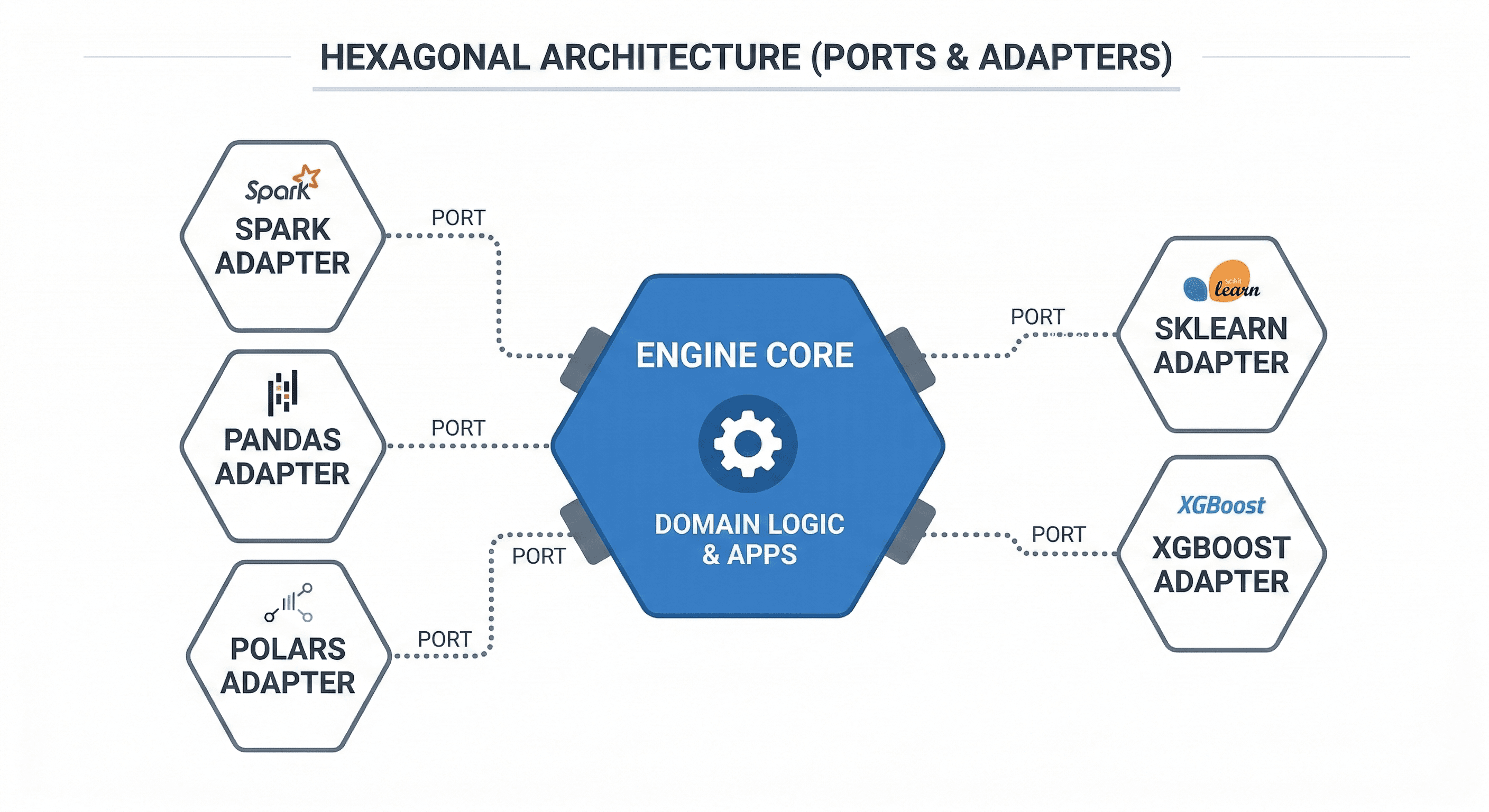
This has a name. It is called hexagonal architecture, also known as ports and adapters. First described by Alistair Cockburn in 2005. The idea: define abstract ports (interfaces) at the system boundary; everything outside connects through adapters it provides. The engine core never depends on the outside world. It defines the shape of the connection and lets adapters fill it.
What makes this interesting in Ubunye's context is that it wasn't deliberately applied as "hexagonal architecture." It emerged from one practical constraint: we don't want to force users to install sklearn just to use the engine. The architectural pattern appeared as a consequence of a pragmatic decision. That's how the best patterns usually arrive: not from a textbook, but from a constraint that turns out to be the right one.
Most ML frameworks do the opposite. They own the ML layer. sklearn's Pipeline.
PyTorch Lightning's Trainer. Hugging Face's Trainer. Excellent tools,
all tightly coupled. If your model isn't sklearn-compatible, you're working
against the framework. If you want to swap PyTorch for JAX, you're rewriting.
Ubunye's model layer doesn't have this problem. A user can implement UbunyeModel
with sklearn today, ONNX tomorrow, and a custom C++ inference server next quarter.
The registry doesn't know or care. It calls save(), stores the artifact, calls
load(), and hands it to predict(). The internals are the user's business.
The inconsistency this POC reveals, and the improvement#
The model layer is correctly designed. But the pattern is incomplete; it only exists in one layer. The rest of the engine has a consistency problem:
Engine (current state):
├── Reads   → pyspark.sql.DataFrame  ← coupled to Spark
├── Writes  → pyspark.sql.DataFrame  ← coupled to Spark
├── Transforms receive Spark DataFrame  ← coupled
└── UbunyeModel.train(df: Any)  ← decoupled ✓
The Any type annotation on train(df: Any) is a symptom. The engine passes a
Spark DataFrame because that's all it knows how to produce, but it annotates it
Any because it doesn't want to import PySpark into the model contract.
The full hexagonal improvement is a DataFramePort:
# ubunye/core/ports.py
from typing import Any, Dict, List, Protocol, runtime_checkable

@runtime_checkable
class DataFramePort(Protocol):
    """Abstract port for any tabular data structure.

    Anything that satisfies this Protocol can flow through the engine.
    Spark DataFrames, pandas DataFrames, Polars DataFrames — all qualify
    without modification, because they already have these methods.
    """

    def schema(self) -> Dict[str, str]:
        """Return column names mapped to type strings."""
        ...

    def count(self) -> int:
        """Return number of rows."""
        ...

    def collect(self) -> List[Dict[str, Any]]:
        """Return all rows as list of dicts."""
        ...
Then lightweight adapters for cases where the native object doesn't satisfy the Protocol natively:
# ubunye/adapters/pandas_adapter.py
class PandasDataFrameAdapter:
    def __init__(self, df): self._df = df
    def schema(self): return {c: str(t) for c, t in self._df.dtypes.items()}
    def count(self): return len(self._df)
    def collect(self): return self._df.to_dict("records")

# ubunye/adapters/polars_adapter.py
class PolarsDataFrameAdapter:
    def __init__(self, df): self._df = df
    def schema(self): return {f.name: str(f.dtype) for f in self._df.schema}
    def count(self): return self._df.height
    def collect(self): return self._df.to_dicts()
What this unlocks:
1. Spark-free unit tests with real data. Currently, engine tests that avoid
Spark use mock objects (fake DataFrames with hard-coded return values). With
PandasDataFrameAdapter, those same tests run on real data, real schema, real
row counts. No SparkSession. No JVM. No Java install on the CI runner.
2. Polars support in 30 lines. Add PolarsDataFrameAdapter. No engine
changes needed. This is exactly what ports and adapters is for: adding a new
implementation behind an existing interface without touching the code that uses it.
3. Local development on a laptop. ubunye run --backend pandas uses pandas
as the execution engine. Same transform() code, same config YAML, same CLI,
running entirely without Spark. Experiment locally, deploy to the cluster when
ready. No environment gap.
4. UbunyeModel.train() becomes consistent. Instead of train(df: Any),
it becomes train(df: DataFramePort). The model knows exactly what interface
it will receive. If it needs the underlying native object (for sklearn, which
needs a numpy array), it calls df.collect() and builds from there.
Why this isn't in the current version:
It's a migration. Every transform() function currently receives a
pyspark.sql.DataFrame. Every Reader.read() returns one. Adding DataFramePort
as the official interface requires a v0.2.0 with a clear migration path.
The right approach for the next phase:
- Ship
DataFramePortas aruntime_checkableProtocol - Verify that Spark DataFrames already satisfy it via duck-typing (they already
have
.schema,.count(),.collect(), so the Protocol check is structural) - Ship
PandasDataFrameAdapteras the local/test backend - Add
--backend pandastoubunye run - Let
UbunyeModel.train(df)acceptDataFramePortin the contract
Who else does this:
- Ibis Project: a Python expression layer over DuckDB, Spark, BigQuery, Polars, pandas. One expression language, any backend. The closest equivalent in the query space.
- Narwhals: a lightweight compatibility layer between dataframe libraries, letting library authors write code that works on pandas, Polars, cuDF, Modin.
- SQLGlot: the same idea applied to SQL dialects: write one SQL, transpile to any backend.
The pattern is established. It is not new. What would be new in Ubunye's context is applying it inside an ETL/ML engine that already has a correctly-designed model layer, extending hexagonal architecture consistently from models down to the data transport layer. That would make Ubunye the only config-driven ETL/ML engine with a fully backend-agnostic data plane. That's a real differentiator.
 #
#
The Documentation Detour#
Every framework eventually needs documentation. The plan was to spend a weekend on it. It took much longer.
MkDocs with the Material theme looked great. The mkdocstrings plugin would
auto-generate API docs from docstrings. git-revision-date-localized would show
when each page was last updated. mkdocs build --strict would catch any warnings
before deploy. Simple.
The first run of mkdocs serve produced this:
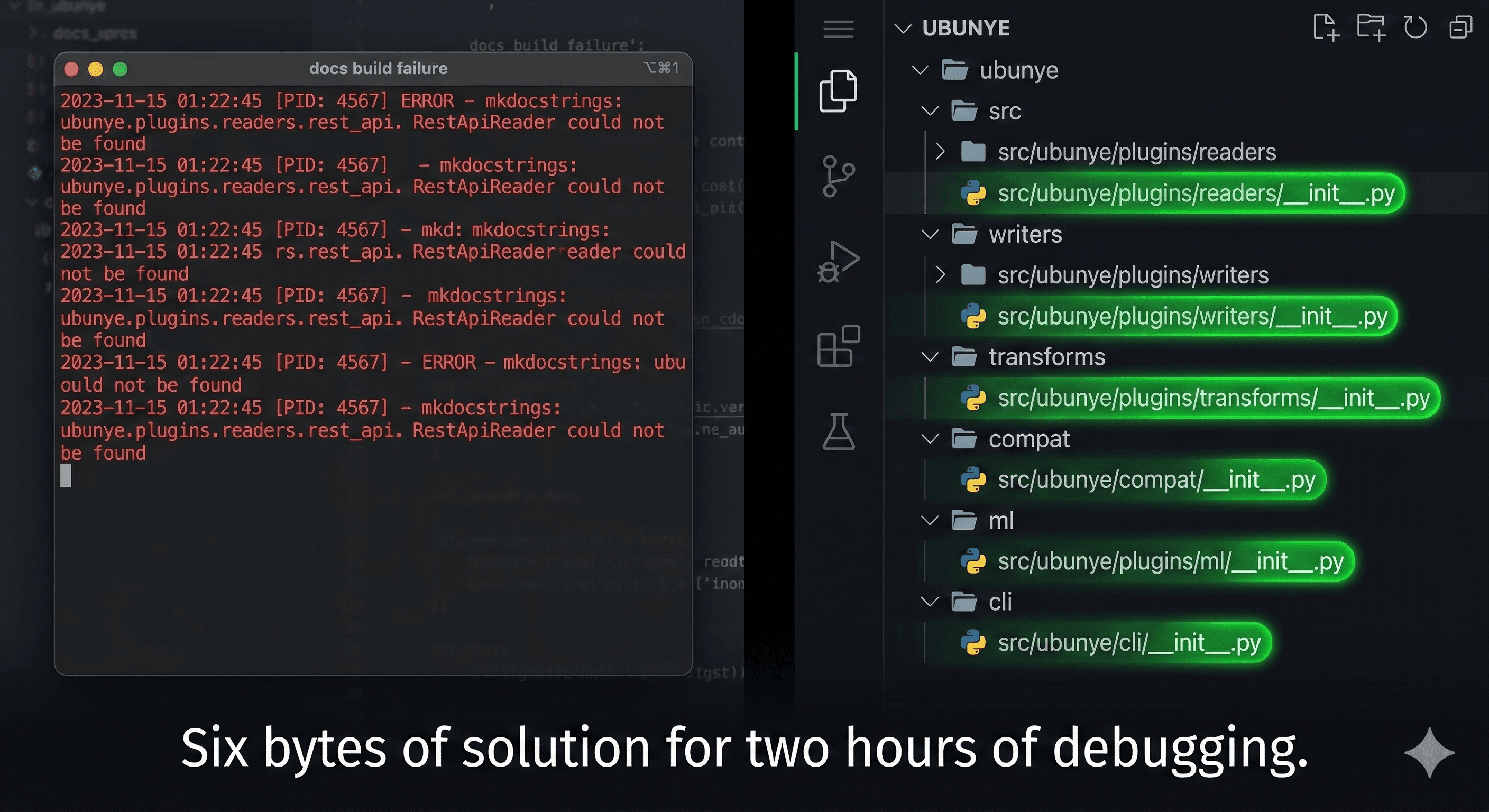
ERROR - mkdocstrings: ubunye.plugins.readers.rest_api.RestApiReader could not be found
Two hours of investigation found two separate root causes, and both had to be fixed:
Cause 1: import requests at the top of rest_api.py failed when requests
wasn't installed in the docs build environment. The fix was lazy imports: move
import requests inside the functions that actually use it, guarded by
TYPE_CHECKING for type annotations:
from __future__ import annotations
from typing import TYPE_CHECKING

if TYPE_CHECKING:
    import requests  # only for type checkers; not loaded at import time
Cause 2: ubunye/plugins/readers/, ubunye/plugins/writers/,
ubunye/plugins/transforms/, and three other sub-packages had no __init__.py.
The griffe AST engine that powers mkdocstrings couldn't traverse them.
It raised a silent KeyError: 'readers' and reported the class as not found.
Six empty files fixed it. Six. Empty. Files.
ubunye/cli/__init__.py
ubunye/compat/__init__.py
ubunye/plugins/ml/__init__.py
ubunye/plugins/readers/__init__.py
ubunye/plugins/transforms/__init__.py
ubunye/plugins/writers/__init__.py
 #
#
The Subtle Bug: When Sampling Returns Nothing#
Between the documentation work, a unit test caught something genuinely tricky.
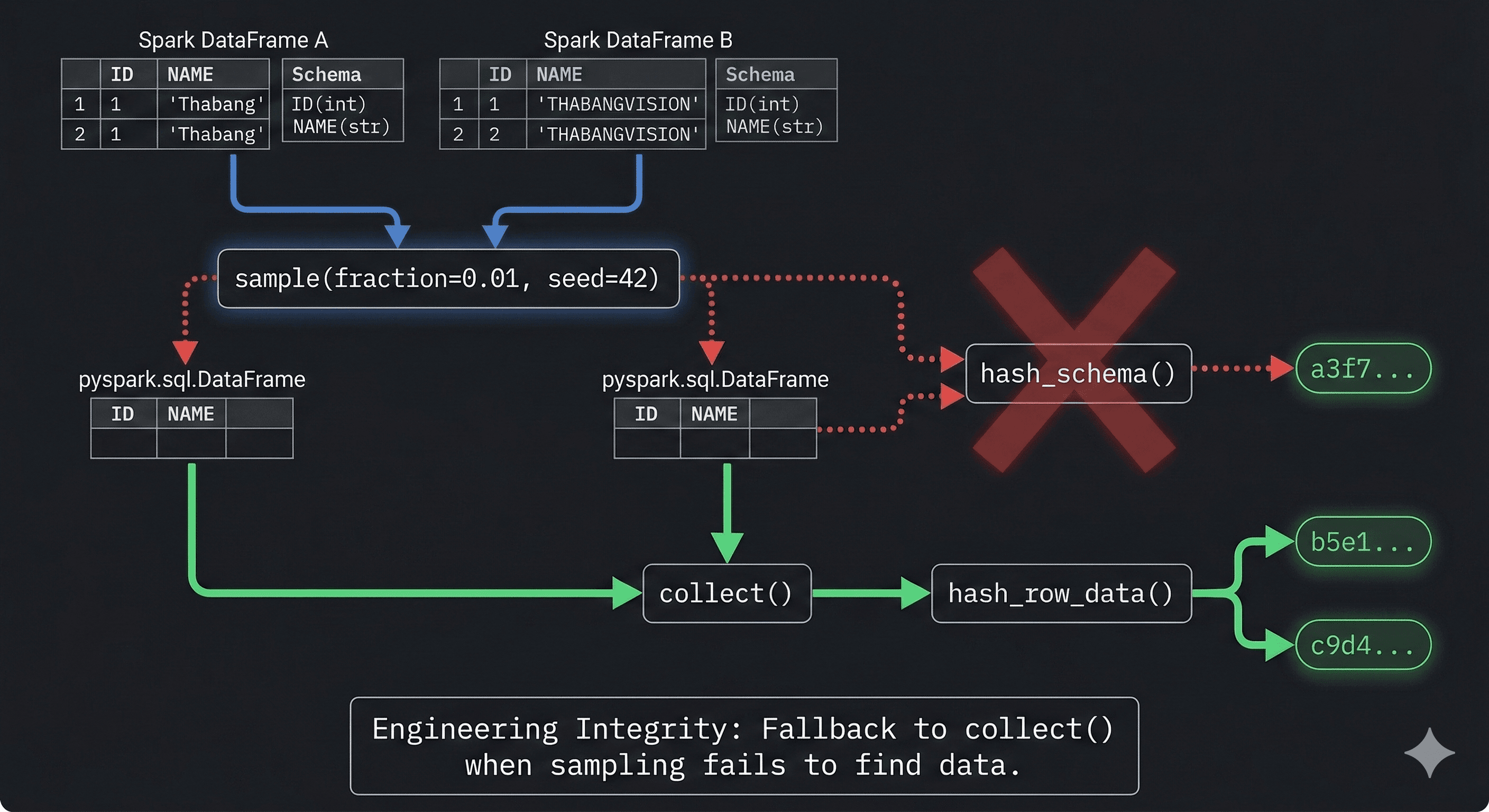
The test test_different_input_different_data_hash was failing: two DataFrames
with different data were producing identical hashes. The hash_dataframe function
sampled rows before hashing them:
sample_rows = df.sample(fraction=0.01, seed=42).collect()
On a 2-row or 3-row DataFrame, fraction=0.01 returns zero rows. The function
then fell back to hash_schema(df), hashing only the column names and types.
Since both test DataFrames had the same schema but different data, the hashes
were identical.
The fix was a single fallback:
sample_rows = df.sample(fraction=0.01, seed=42).collect()

if not sample_rows:
    # DataFrame too small for fractional sampling — collect all rows instead
    sample_rows = df.collect()

if not sample_rows:
    return hash_schema(df)
Three lines. But the regression test needed to document why this exists, because otherwise someone will "clean it up" in six months and reintroduce the bug:
def test_empty_sample_falls_back_to_collect_not_schema():
    """
    Regression: df.sample(0.01) returns empty on 2-3 row DataFrames.
    Without the collect() fallback, both DataFrames hash to hash_schema()
    — identical — even though their data differs.
    """
 #
#
CI/CD: The Perpetual Game of Whack-a-Mole#
GitHub Actions was supposed to be set-and-forget. It was not.
Problem 1: Missing dev dependencies.
The test workflow ran pytest --cov=ubunye --timeout=300. Both flags required
packages that weren't in pyproject.toml's dev extras:
# Before — silently broken
dev = ["pytest", "black", "ruff", "build"]

# After — actually works
dev = ["pytest", "pytest-cov>=4", "pytest-timeout", "hypothesis>=6",
       "requests>=2.28", "black", "ruff", "build"]
Problem 2: setuptools flat-layout refusing to build.
The build backend auto-discovers packages in a "flat layout" (packages at the
repo root). The repo had both ubunye/ and pipelines/ at the root. setuptools
refused:
Multiple top-level packages discovered in a flat-layout: ['ubunye', 'pipelines']
The pipelines/ directory contains example pipeline tasks; it's not a Python
package, but setuptools didn't know that. Fix:
[tool.setuptools.packages.find]
include = ["ubunye*"]
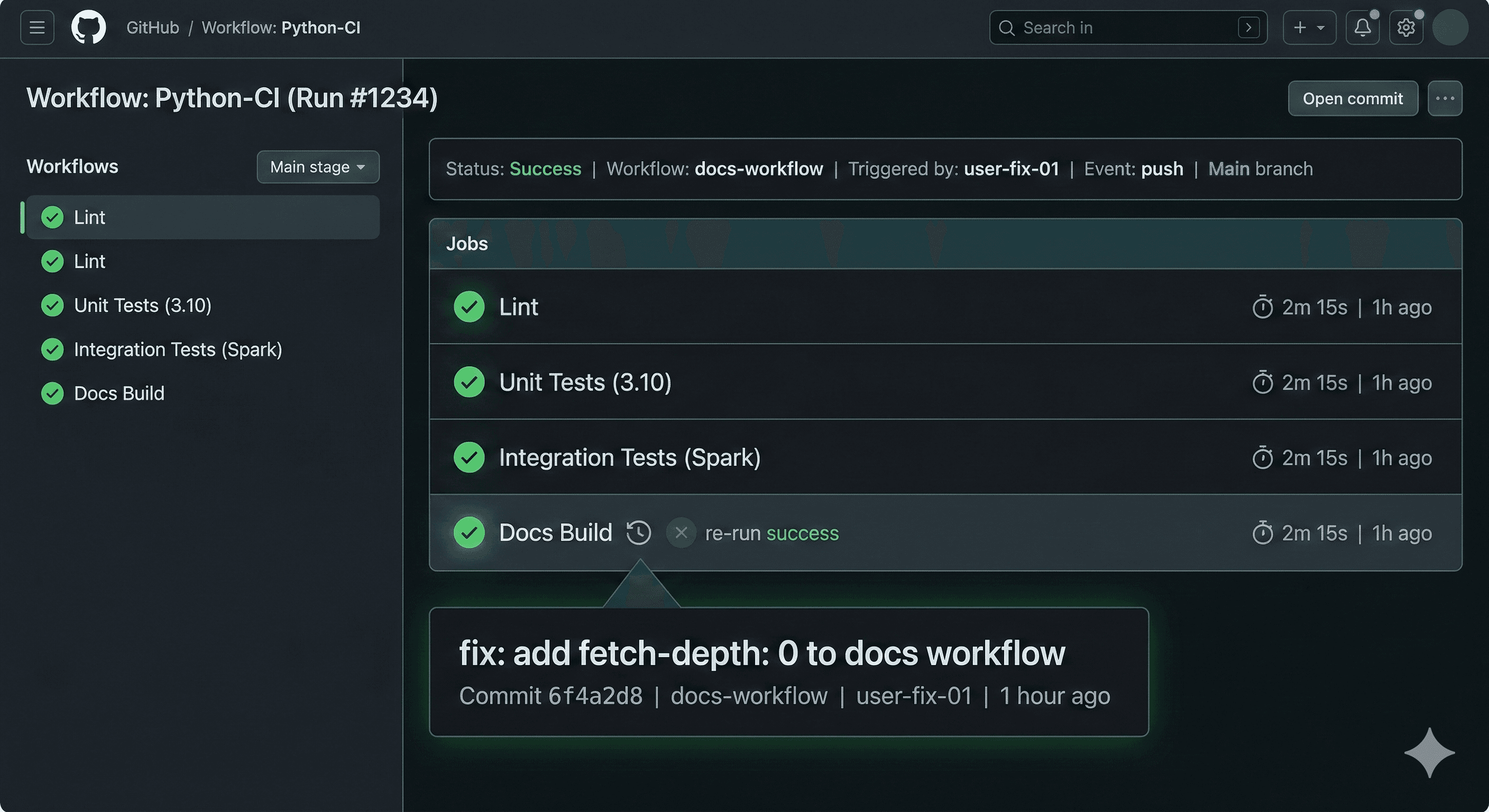
Problem 3: GitHub Pages 404.
The docs workflow was building successfully locally but the deployed site was
returning 404. The git-revision-date-localized plugin requires full git history
to calculate when pages were last modified. The default actions/checkout does a
shallow clone (fetch-depth: 1). With --strict mode, the plugin warning became
an error, the build silently succeeded with empty output, and gh-pages branch
was never updated.
# The one line that fixed it
- uses: actions/checkout@v4
  with:
    fetch-depth: 0   # full history required by git-revision-date-localized
Problem 4: Dead import caught by ruff.
After moving import requests to lazy imports inside _build_session(), the
HTTPBasicAuth import was still sitting in the TYPE_CHECKING block, imported
but never used as a type annotation (it was only used locally inside the function):
F401: 'requests.auth.HTTPBasicAuth' imported but unused
Two lines deleted. CI green.
 #
#
The PyPI Publish Workflow#
Publishing to PyPI should be the easy part. A version tag, a workflow file, done.
The question was authentication method. The older approach uses a PYPI_API_TOKEN
secret and the twine tool:
- name: Upload to PyPI
  run: twine upload dist/*
  env:
    TWINE_USERNAME: __token__
    TWINE_PASSWORD: ${{ secrets.PYPI_API_TOKEN }}
The modern approach uses OIDC Trusted Publishers: no secret to rotate, no token to leak, no expiry to forget:
environment: pypi
permissions:
  contents: read
  id-token: write          # OIDC token for PyPA Trusted Publisher

- name: Publish to PyPI
  uses: pypa/gh-action-pypi-publish@release/v1
  # No password needed — OIDC handles authentication
The trigger is a version tag. Nothing runs until:
git tag v0.1.1
git push origin v0.1.1
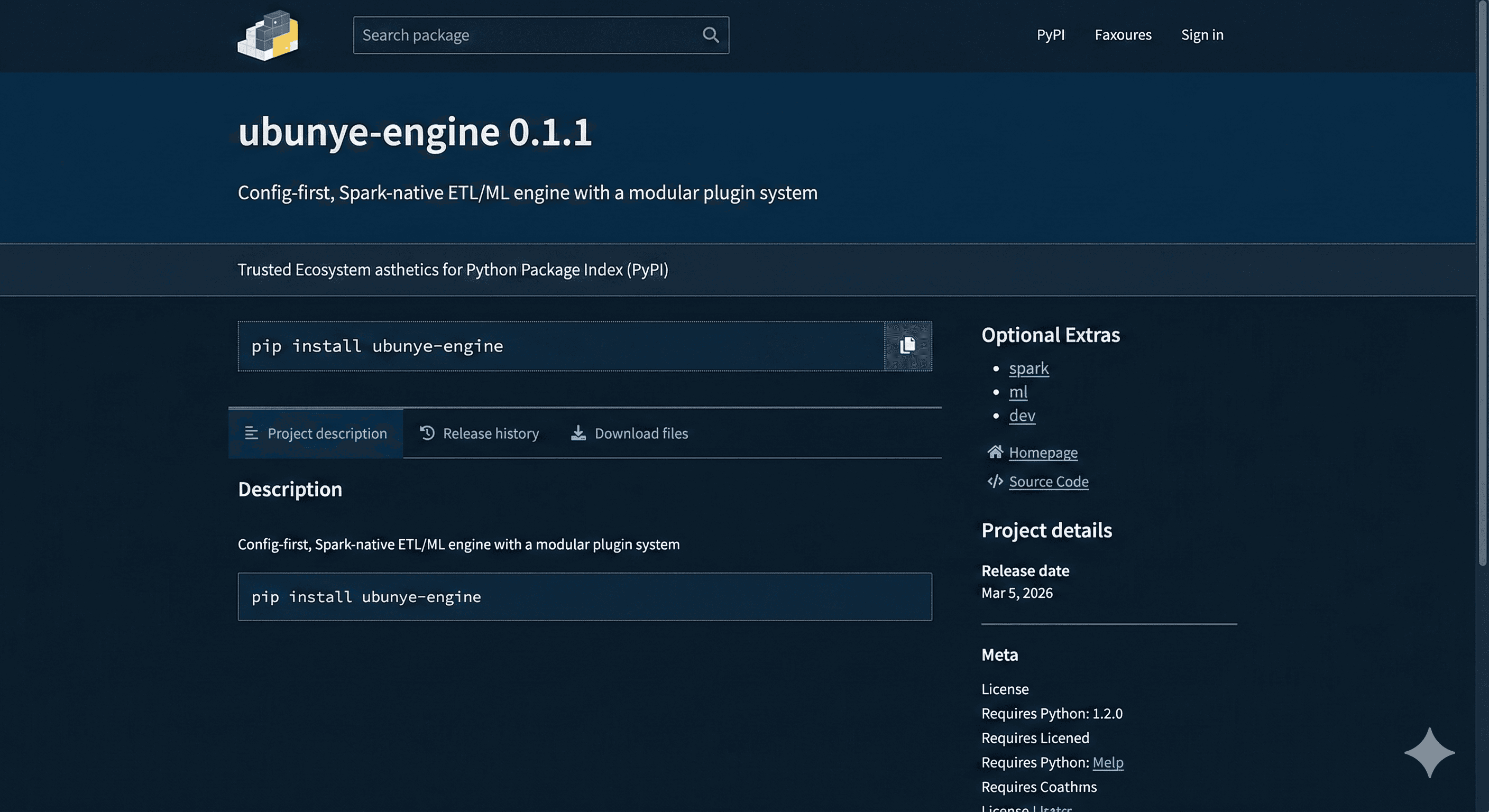
That's the moment it becomes real. A public package. Importable by anyone.
pip install ubunye-engine.
 #
#
The Version Problem (And Its Elegant Solution)#
ubunye/__init__.py had this:
__version__ = "0.1.1"
Every time the version changed in pyproject.toml, someone had to remember to
update __init__.py too. Someone always forgot. The ubunye version CLI command
would show the wrong version. Users would open issues.
The fix is one of Python's most underused standard library features:
from importlib.metadata import PackageNotFoundError, version

try:
    __version__ = version("ubunye-engine")
except PackageNotFoundError:
    __version__ = "unknown"
importlib.metadata reads the installed package metadata, which comes directly
from pyproject.toml. One source of truth. The PackageNotFoundError guard
handles the case where someone runs the code directly from a cloned repo without
installing it first.
Proving It Works: Kaggle#
After all the unit tests and integration tests and CI pipelines, the question remained: does it actually work on real data?
The Titanic dataset on Kaggle became the proving ground. No Hive metastore. No S3. No Databricks. Just Python, pandas, and the engine contracts.
The journey started well with config loading and CLI commands. Then the first real mistake:
# My example code said:
recorder = LineageRecorder(store_object)
recorder.start_run("titanic_pipeline", "1.0.0", {"env": "kaggle"})

# The actual API is:
recorder = LineageRecorder(store="filesystem", base_dir="...")
recorder.task_start(context=ctx, config=config)
The error came immediately:
AttributeError: 'LineageRecorder' object has no attribute 'record_step'
Honest mistake. The documentation said one thing, the example code said another. Fixed, documented, moved on.
Then the config validation error:
ValidationError: MODEL
  Input should be 'etl' or 'ml'
MODEL: "titanic_etl", of course. MODEL is a job type classifier (JobType
enum), not a human-readable pipeline name. The human name lives in the folder
structure. MODEL: "etl". Fixed.
Then the lineage inspection:
for fname in os.listdir("/kaggle/working/.ubunye/lineage"):
    with open(f".../{fname}") as f: ...

# IsADirectoryError: [Errno 21] Is a directory: '.../lineage/titanic'
The lineage store doesn't write flat files in the root. It writes them under
{usecase}/{package}/{task}/. Use os.walk. Three-line fix.
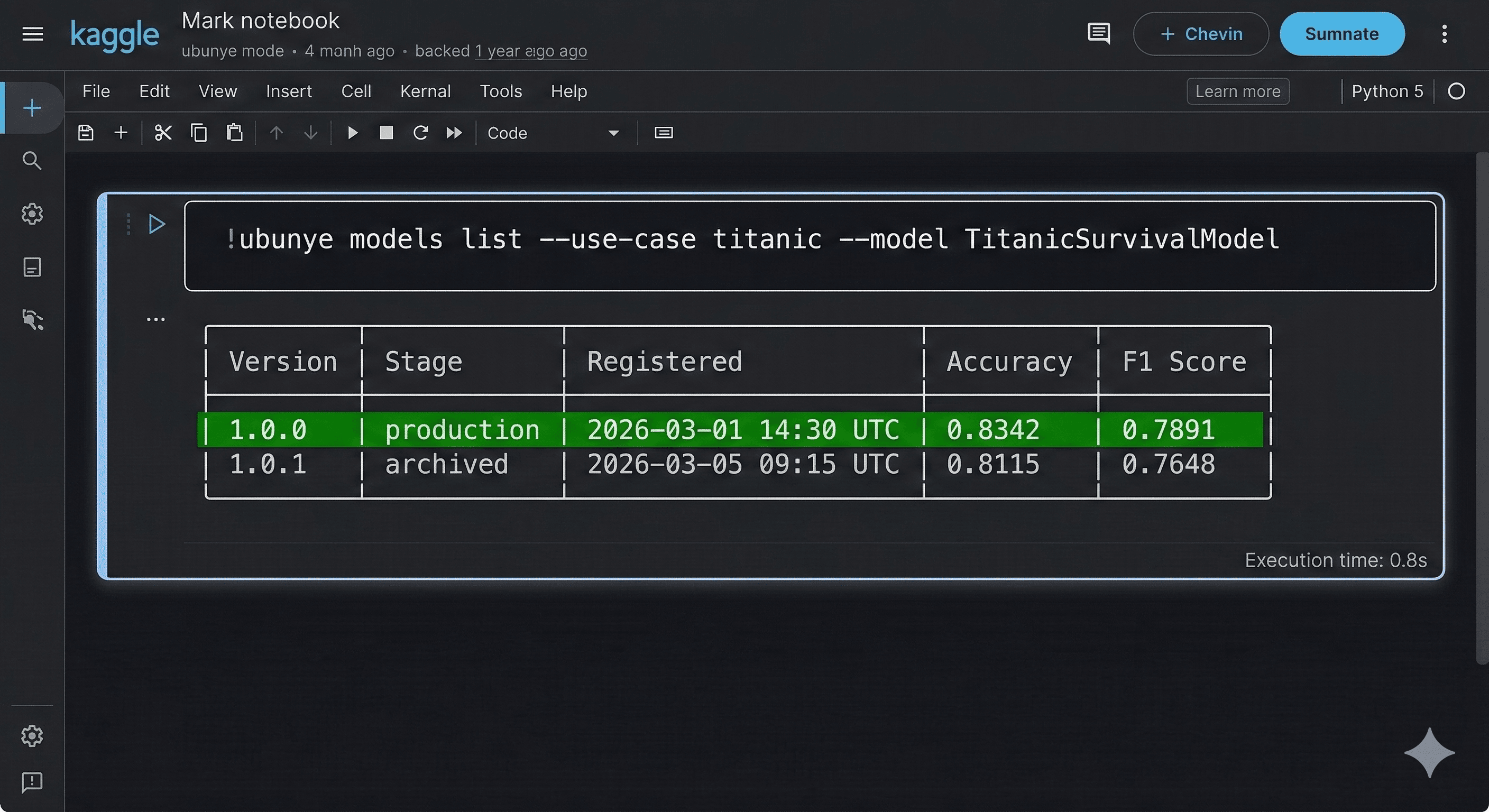
The End-to-End Notebook#
The final artefact of the whole journey is a single Jupyter notebook:
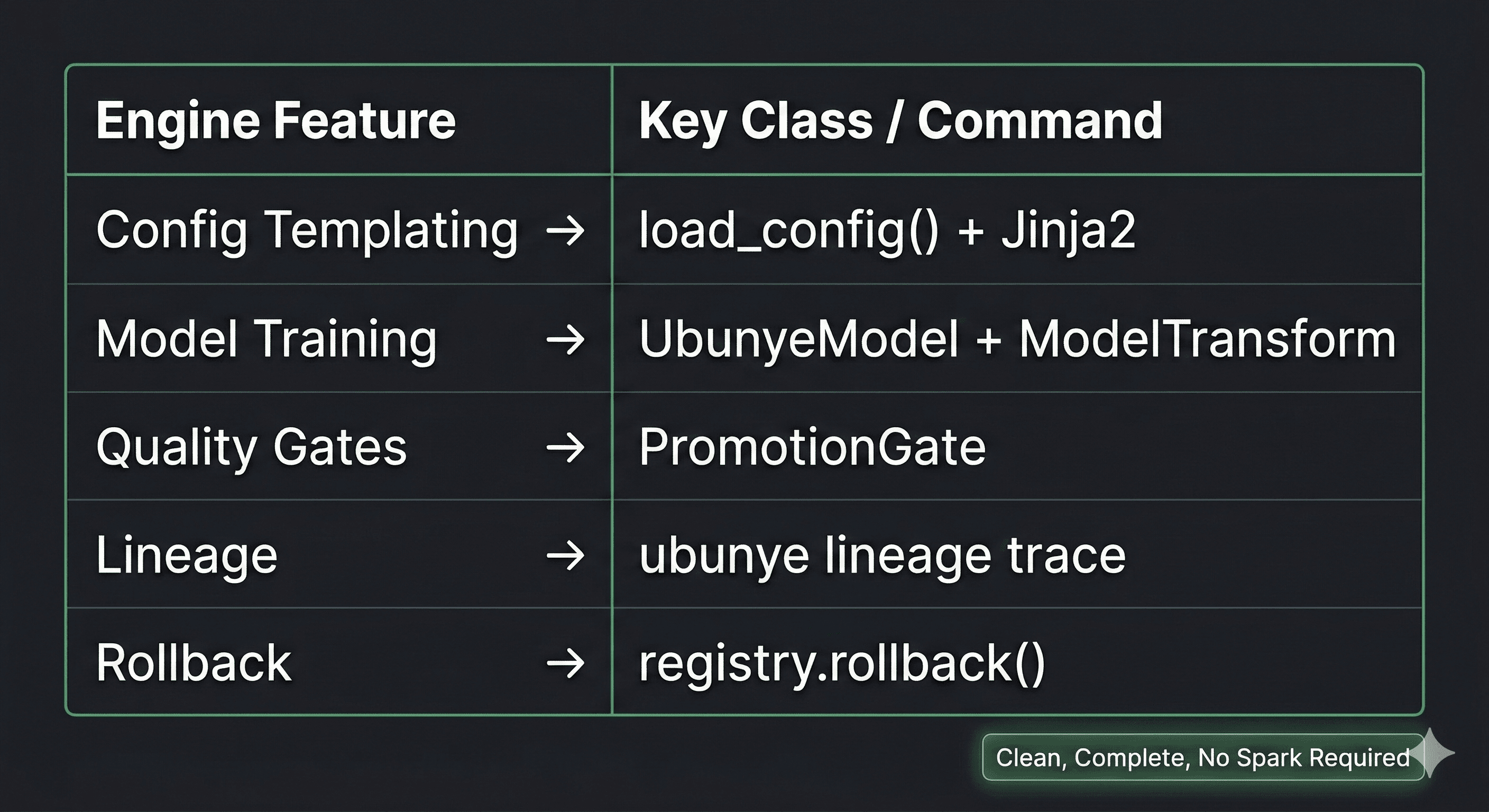
examples/titanic_end_to_end.ipynb. It covers, in order:
ubunye init, scaffold the use-case folder structure- Three config files with Jinja2 templating and dev/prod profiles
ubunye validateandubunye planbefore touching dataRawIngestTask, clean raw passenger records, record lineageFeatureEngineeringTask, engineer survival features, log to MLflowTitanicSurvivalModel(UbunyeModel), sklearn RF, library-independent contractModelTransform(action=train), train, register, auto-promote via gatesPromotionGate, enforce quality thresholds before productionModelTransform(action=predict), load from registry by stage, score test setubunye lineage list/show/trace/compare/search, full audit trail- Train v2, compare versions, rollback, archive, full maintenance cycle
From pip install to a production-ready, versioned, monitored, lineage-tracked
ML pipeline. In one notebook. On a free Kaggle GPU.
What Kaggle Doesn't Prove, And What I Still Need to Find Out#
The Titanic dataset has 891 rows. Spark is overhead at 891 rows. The notebook proves the contracts work and the engine runs end-to-end. It does not prove anything about the environment where Ubunye is actually meant to operate.
Production looks different: 50 million rows with schema drift between runs.
Five pipelines running concurrently on a shared cluster. An engineer who didn't
build the framework trying to write their first transformations.py at 4pm on
a Friday. A model that passed all promotion gates but started degrading three
weeks after go-live because the upstream feature engineering changed.
I intend to test this in my current role, on actual production-scale data, with an actual team, against real SLA pressure. That's a different test from Kaggle. It's the test that matters.
I'll come back with that feedback. The framework passed its own tests. Whether it survives contact with a real data team, over time, with engineers who didn't build it. That's what I'll find out.
What "Done" Actually Means#
The repository now has:
- 261 tests: unit and integration, Spark-free and Spark-full
- Full CI/CD: lint, unit matrix (3.9/3.10/3.11), integration (Spark + Java 17), docs build, PyPI publish on tag
- MkDocs documentation site: auto-deployed to GitHub Pages on every push to main
- Model Registry: filesystem-backed, versioned, lifecycle-managed
- Lineage recording: every run is an auditable JSON record
- MLflow integration: opt-in telemetry, zero coupling to the core engine
- CLI:
ubunye init,validate,plan,run,plugins,version,lineage *,models *,test run - End-to-end example: Titanic, real data, all features exercised
There is still no magic. The engine doesn't write your business logic for you. It doesn't decide what features to engineer or what model to use. It doesn't guess your schema or predict your data drift.
What it does is make everything around your business logic reliable, observable,
and repeatable. Your transform() function stays pure. The engine handles the
rest.
The Honest Retrospective#
If I had to do it again, the things I'd change:
Start CI earlier. The missing dev dependencies lived undetected for weeks
because the first version of the CI only ran pytest tests/unit/ without
coverage or timeout flags. A proper CI setup on day one would have caught this
in the first commit.
Add __init__.py files at scaffold time. The griffe traversal failure
was entirely preventable. Any sub-package that contains importable Python code
should have __init__.py. This is not a new rule. It's been true since Python 2.
Write the docs as you build, not after. Documentation written after the fact is archaeology. You have to re-excavate design decisions you made six weeks ago and try to explain them to a stranger. Documentation written alongside the code captures the why while it's still fresh.
Test your own examples. The incorrect LineageRecorder API in the Kaggle
example was embarrassing. If I had run the code before publishing it, that would
never have shipped. Always run the example. Always.
Human + Agent: The Real Numbers#
This project was built with an AI coding agent as a collaborator throughout. That fact has been implicit in the whole story: the error messages, the corrections, the back-and-forth. It's worth making it explicit and honest, because the numbers tell a story that the AI industry mostly avoids having.
How long would this have taken alone?#
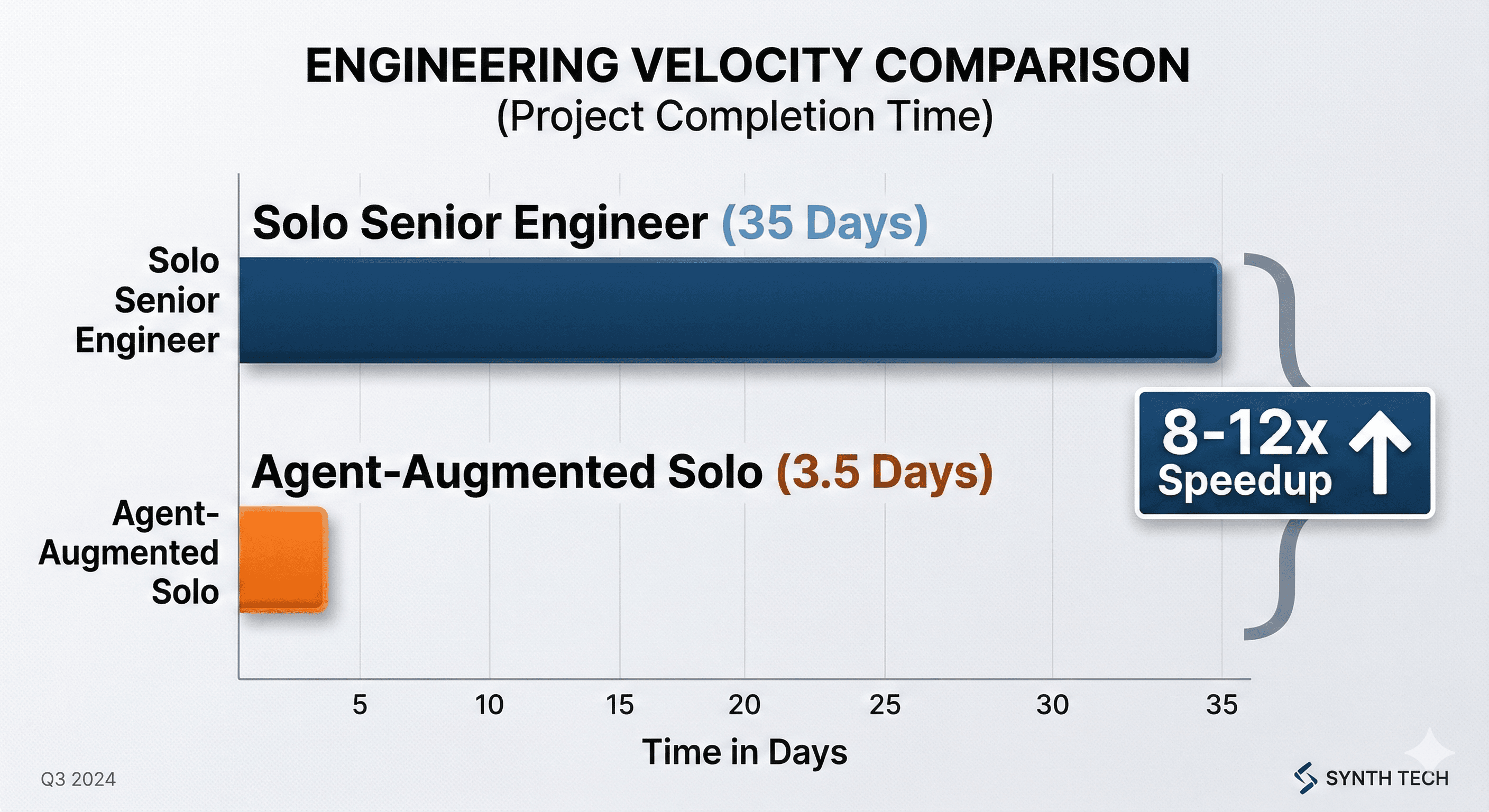
The honest estimate for a senior data engineer building this solo, no AI assistance:
| Phase | Solo estimate |
|---|---|
| Config system (YAML + Jinja2 + Pydantic v2 + profiles) | 4-5 days |
| Lineage tracking (RunContext, hasher, store, recorder, CLI) | 3-4 days |
| Test infrastructure (261 tests, unit + integration, fixtures) | 4-6 days |
| Access control | 1-2 days |
| Model Registry (base, loader, registry, gates, transform, 40 tests) | 8-12 days |
| Readers/Writers (REST API, S3, lazy imports) | 2-3 days |
| MkDocs documentation site (warnings, nav, mkdocstrings) | 2-3 days |
| CI/CD (3 workflows + all the debugging) | 2-3 days |
| Kaggle example notebook | 1-2 days |
| Blog | 0.5 days |
| Total | 27-40 days |
That's 5-8 weeks of full-time engineering work. Conservative estimate.
How long did it actually take with the agent?#
Counting actual human hours spent (architecture decisions, reading generated code, reviewing tests, directing the next step, catching errors, re-explaining context after session resets):
| Phase | With agent (human hours) |
|---|---|
| Config system | 3-4 hours |
| Lineage tracking | 2-3 hours |
| Test infrastructure | 3-4 hours |
| Access control | 1-2 hours |
| Model Registry | 5-6 hours |
| Readers/Writers | 1-2 hours |
| Documentation | 3-4 hours |
| CI/CD debugging | 2-3 hours |
| Kaggle notebook | 2-3 hours |
| Blog | 1 hour |
| Total | ~23-31 hours |
Roughly 3-4 full working days of human effort.
The speedup is approximately 8-12× on elapsed time.
What a team would have cost, and whether agents replace developers#
The honest comparison isn't solo-vs-agent. It's team-vs-agent-augmented-solo.
A realistic team to build this from scratch: one senior data/ML engineer and two mid-level data engineers.
South African market rates (2025):
| Role | Annual salary | Daily rate (22 days/month) |
|---|---|---|
| Senior Data/ML Engineer | R850,000/year | ~R3,200/day |
| Mid-level Data Engineer | R520,000/year | ~R2,000/day |
For 35 working days of active development (the low end of the solo estimate):
| Cost item | Amount |
|---|---|
| Senior engineer × 35 days | R112,000 |
| Mid-level × 2 × 35 days | R140,000 |
| Team overhead (standups, PRs, code reviews, coordination, 20%) | R50,400 |
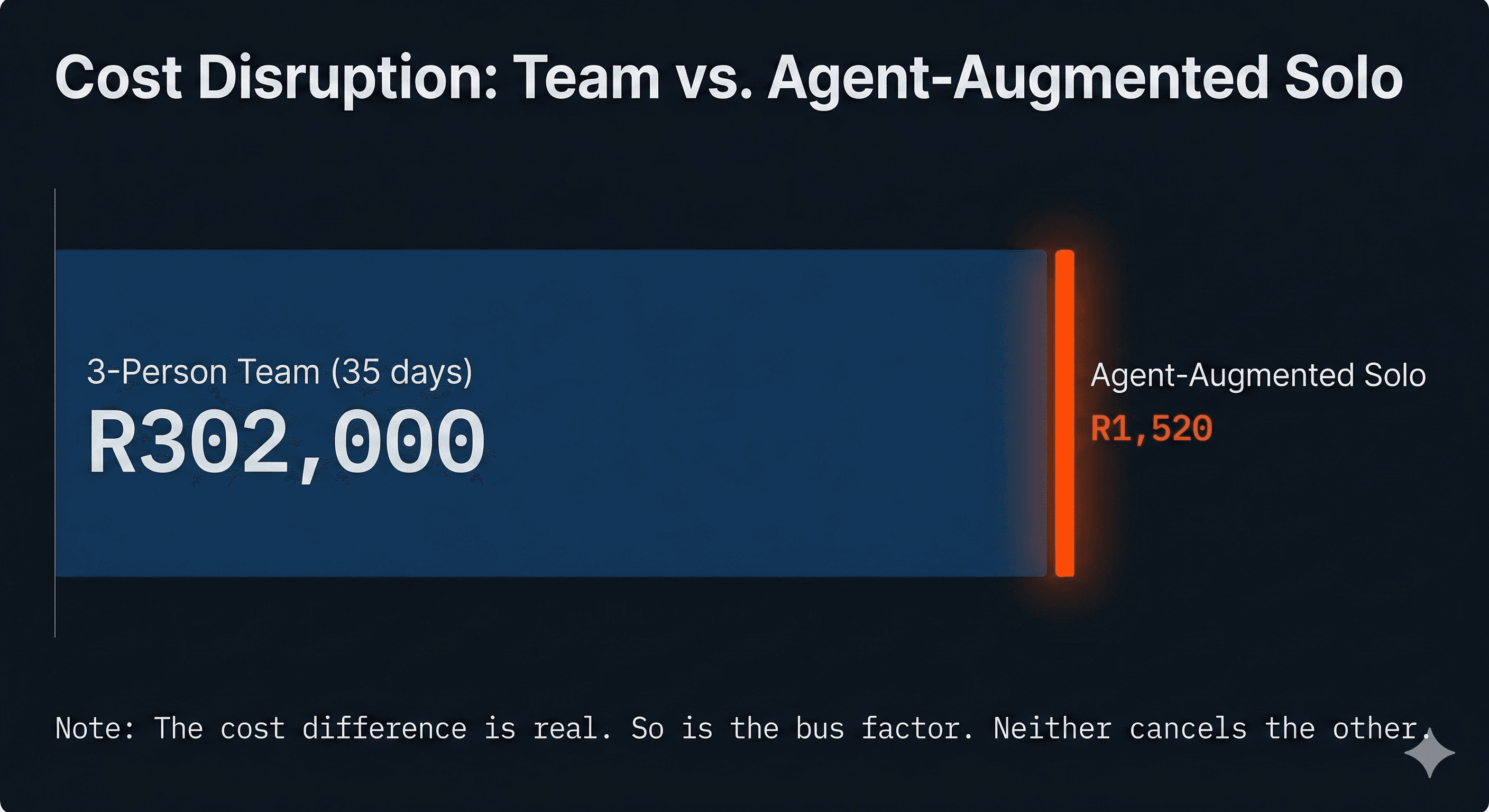
| Total | ~R302,000 |
Agent-augmented solo total: R1,520.
That is a 200× cost reduction on the development of this specific framework.
Before concluding that agents replace developers, read that number carefully.
The R302,000 team would have produced something the agent-augmented solo didn't: a codebase understood by three people. Three people who can maintain it, extend it, and debug it at 3am without the original author present. The agent doesn't stay. When the session ends, it forgets everything. The bus factor of agent-built code is 1: the human who directed it.
Does this mean agents replace developers? No. It means something more specific: one engineer who knows how to direct an agent can deliver what previously required a team, for a fraction of the cost, in a fraction of the time. The tradeoff is that all the domain knowledge lives in one head instead of three. For a greenfield POC that needs to prove itself before a team is justified, that tradeoff is correct. For a production system that needs to outlive its creator, that tradeoff needs to be actively managed through documentation, tests, and the kind of CI discipline this project demonstrates.
The real question is not "agents or engineers?" It's "what stage is this at, and what does this stage need?" Early stage: agent-augmented solo is dramatically more efficient. At scale: a team that uses agents collectively is more efficient than a team that doesn't.
[Image: A cost comparison bar chart. Left bar: "3-person team, 35 days", R302,000. Right bar: "Agent-augmented solo", R1,520. The scale makes the right bar almost invisible. A note at the bottom: "The cost difference is real. So is the bus factor. Neither cancels the other."]
The experience compression, and why seniors benefit more than juniors#
This is the part nobody in the AI industry talks about directly.
The skills required to build Ubunye Engine solo, without an agent:
| Skill domain | Experience needed |
|---|---|
| Apache Spark (production ETL, partitioning, shuffle tuning) | 3-5 years |
| Python packaging (pyproject.toml, entry points, OIDC PyPI) | 2-3 years |
| Pydantic v2 (released 2023; many engineers still on v1) | 6 months-1 year |
| MkDocs + mkdocstrings (griffe AST, strict mode, nav config) | 6 months |
GitHub Actions (multi-job matrix, OIDC auth, fetch-depth) | 1-2 years |
| ML lifecycle management (versioning, gates, promotion, rollback) | 3-5 years |
| Abstract interface design (ports-and-adapters, plugin entry points) | 5-8 years |
| Total (with realistic overlap) | 8-12+ years of diverse, production experience |
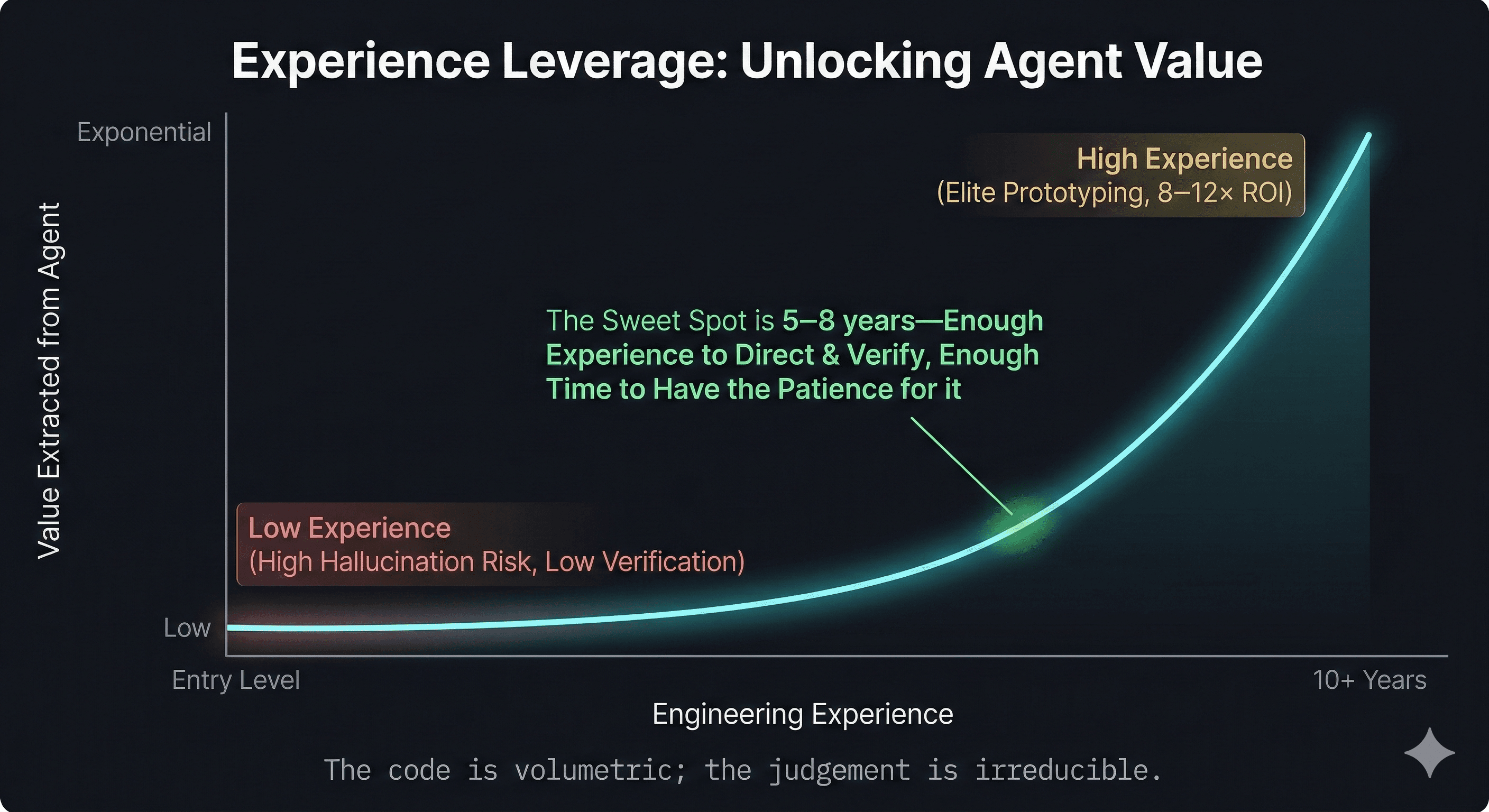
With an agent: roughly 5-7 years of experience to use effectively. Not because the agent does the easy parts. It does the volumetric parts. You still need enough experience to design the architecture, evaluate what the agent produced, catch hallucinated APIs, and know when the output is wrong in a non-obvious way.
This is the counterintuitive result: AI coding agents give more leverage to senior engineers than to juniors. Not less.
A junior engineer with an agent generates code at a rate they cannot verify.
They cannot catch the LineageRecorder.record_step hallucination because they
don't know the actual API. They cannot evaluate whether a DataFramePort design
is architecturally sound. They cannot spot the empty-sample fallback bug because
they don't have the mental model of how Spark's fractional sampling behaves on
small DataFrames.
A senior engineer with an agent generates code at a rate they can verify, and the agent handles everything they would otherwise have to type themselves. The amplification is real because the verification capacity exists to match it.
This doesn't make agents useless for junior engineers. It means the value they extract is lower, and the risk they carry is higher, until their verification capacity catches up. The path for juniors is: use agents to learn faster, not to skip learning.
Where the agent genuinely accelerated things#
The agent was fastest on work that is structurally clear but volumetrically large:
- Writing 261 tests across 30 files once the testing patterns were established
- Implementing the 7 model registry methods once the storage layout was designed
- Writing 6 lineage CLI commands once the first one existed as a template
- Generating the full MkDocs navigation once the doc structure was planned
- The entire Kaggle notebook once the section structure was agreed
In all of these cases, the agent understood the pattern from one or two examples and could replicate it at scale without degradation. The work that would have taken a human a full day took an hour of direction and review.
Where the agent failed or slowed things down#
This is the part that doesn't make it into AI company marketing materials.
1. API hallucination. The agent wrote Kaggle example code using APIs that don't exist:
# Agent's example (wrong):
recorder = LineageRecorder(store_object)
recorder.start_run("pipeline", "1.0.0", {})

# Actual API:
recorder = LineageRecorder(store="filesystem", base_dir="...")
recorder.task_start(context=ctx, config=config)
The code looked plausible. It compiled. It failed at runtime with AttributeError.
The agent had read the LineageRecorder class earlier in the session, then
invented a simpler API that felt right. This cost a debugging round.
2. Context degradation across sessions. The project spanned multiple long conversations. At the start of each session, the agent had to re-read files to reconstruct what existed. Design decisions made three sessions ago were occasionally re-invented differently. A human working continuously carries that context in their head for free.
3. The "plausible but wrong" problem. The hash_dataframe empty-sample bug was subtle: the code was correct for large DataFrames and silently wrong for small ones. The agent wrote the regression test correctly once the bug was explained, but didn't catch the bug during initial implementation. Neither would most humans on first read. The point is: the agent produces code that looks right at a rate that exceeds a human's ability to verify right.
4. Over-generation. Asked to add a section, the agent adds the section plus related error handling plus a helper function plus a docstring. Asked to fix a bug, it sometimes refactors surrounding code that didn't need touching. Every unrequested addition is work you have to review and potentially undo. Discipline about scope is a human responsibility; the agent defaults to more.
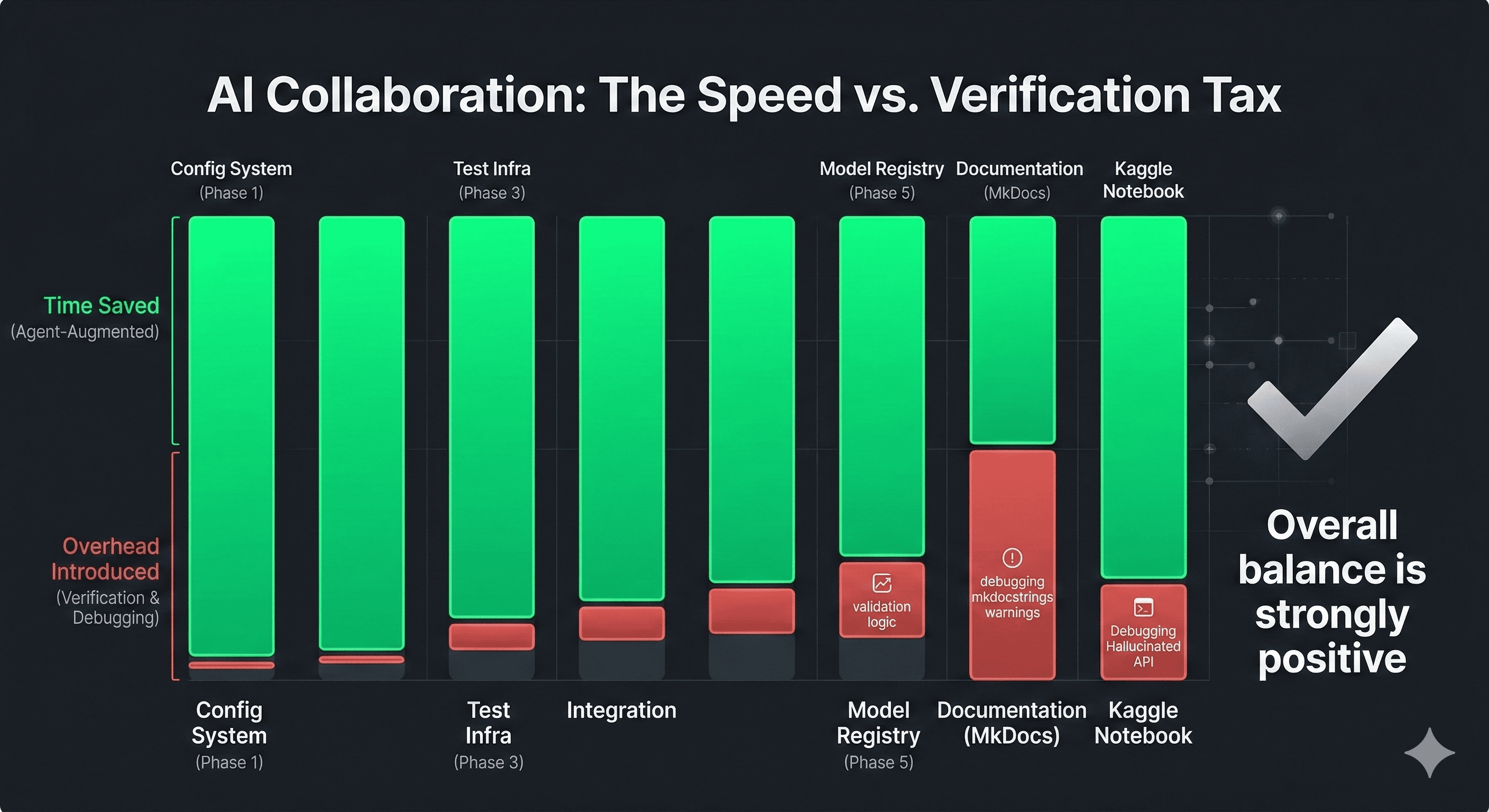
5. The verification tax. 261 tests generated quickly still need to be read. 30 files of code still need to be understood. The agent compresses the writing time dramatically but the review time is irreducible, and it's harder to review code you didn't write than code you did. You're always slightly behind the output.
[Image: A split bar showing "time saved" vs "overhead introduced" for each phase. Most phases show large savings and small overhead. The documentation phase shows moderate savings with notable overhead (back-and-forth on warnings). The Kaggle notebook shows large savings but a visible "debugging wrong API" overhead band in red. The overall balance is strongly positive but not uniformly so.]
What this means for "vibe coding"#
Vibe coding (the practice of generating code with AI and accepting it without deeply understanding it) works fine for throwaway scripts and prototypes where the cost of being wrong is low.
It does not work for a framework with a public API, 261 tests, and users who
will pip install it.
The reason is simple: you cannot debug a codebase you don't understand. When the hash_dataframe bug appeared, identifying it required knowing exactly how the hasher was supposed to work, what the fallback chain was, and why a 2-row DataFrame would behave differently than a 200-row one. That understanding came from the architectural decisions made before the code was written, decisions that were human, not agent.
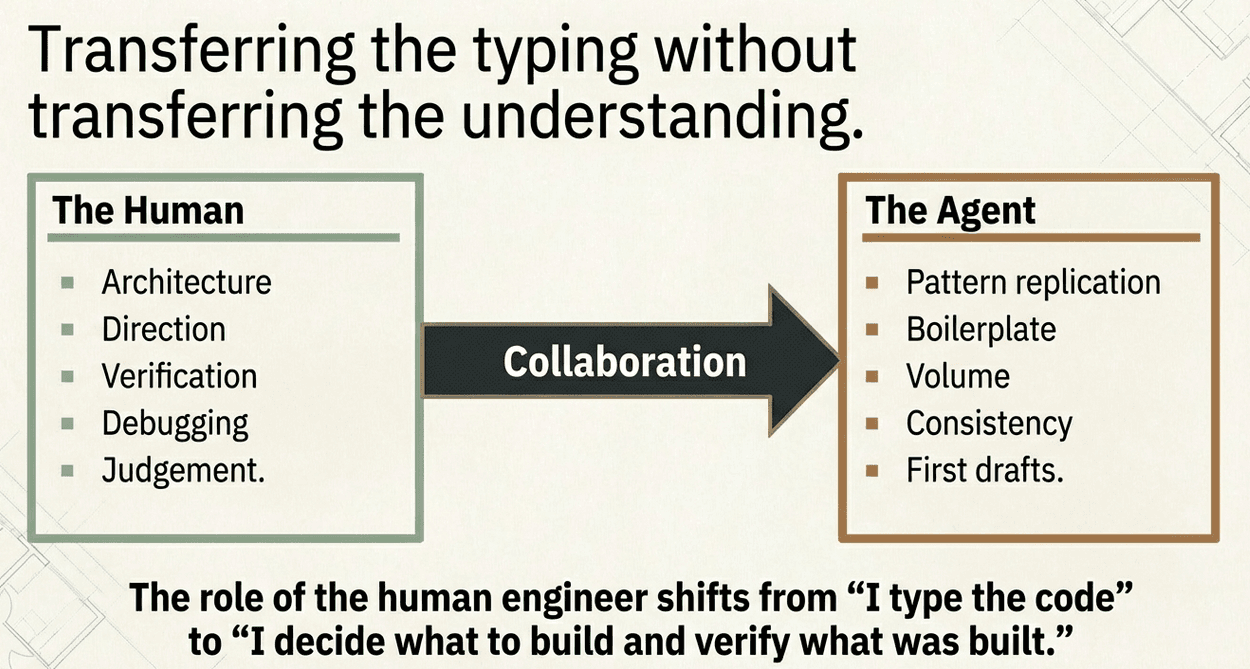
Vibe coding transfers the typing to the agent. It cannot transfer the understanding. And when production breaks at 3am, understanding is the only thing that matters.
The real shift#
The role of the human engineer changes, but it doesn't diminish. It shifts from:
"I type the code"
to:
"I decide what to build, verify what was built, catch what's wrong, and direct what comes next"
That is harder than it sounds. Reviewing 261 tests across 30 files, asking whether each test is testing the right thing, not just whether it passes, is genuinely skilled work. Architectural decisions about promotion gate design or lineage storage layout are not things an agent can make for you. Catching an API hallucination requires knowing the actual API.
The engineer who can do those things well, and who uses an AI coding agent to handle the volumetric work, is dramatically more productive than one who does either alone.
The engineer who accepts agent output without verification is not coding. They are accumulating liability.
The Bill: What This Actually Cost in Rands#
These are not estimates. The session JSONL file was parsed to get the exact numbers.
Raw token usage (one primary session)#
| Metric | Count |
|---|---|
| API turns (back-and-forth exchanges) | 1,008 |
| Input tokens (fresh user messages) | 66,399 |
| Output tokens (agent-generated code, explanations) | 421,557 |
| Cache read tokens | 95,038,923 |
| Cache write tokens | 6,877,864 |
| Total non-cache tokens | 487,956 |
That cache read number, 95 million, is not a typo.
What it cost#
Using claude-sonnet-4-6 API rates (input: 15/M, cache read: 3.75/M):
| Category | Tokens | Cost (USD) | Cost (ZAR @ R18.8) |
|---|---|---|---|
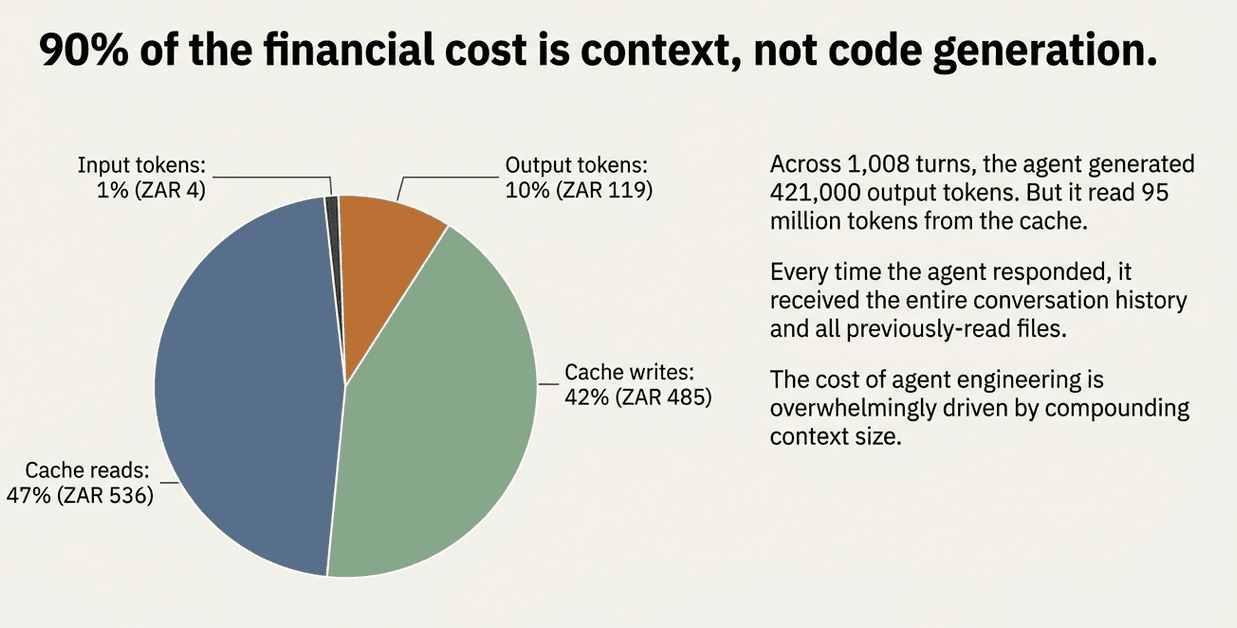
| Input (fresh) | 66,399 | $0.20 | R3.76 |
| Output | 421,557 | $6.32 | R118.82 |
| Cache reads | 95,038,923 | $28.51 | R536.00 |
| Cache writes | 6,877,864 | $25.79 | R484.86 |
| Total | $60.83 | R1,143.53 |
Plus the Claude Pro subscription: $20/month = R376/month.
Total cost of this project: approximately R1,520, subscription plus API value consumed. For 3-4 days of equivalent engineering output that would have taken 5-8 weeks alone, that is an extraordinarily good deal. But only if you understand where the money went.
Where 90% of the cost went, and why#
The pie chart tells the story. 90% of the bill is cache operations, not code generation.
Here is what happened: every time the agent responded, it received the entire conversation history plus all previously-read files as cached context. By turn 500, a single API call was carrying the entire codebase, every error message, every correction, every file read from the previous 499 turns, even the ones that were no longer relevant.
The session lasted 1,008 turns. Across those turns, 95 million tokens were read from cache, the same accumulated context, re-sent on every exchange, growing heavier with each one.
This is how Claude Code's prompt caching works: it is very fast (cache reads are 10× cheaper than fresh input) but it accumulates. A long single session with heavy file reading is structurally expensive.
Where tokens were specifically wasted#
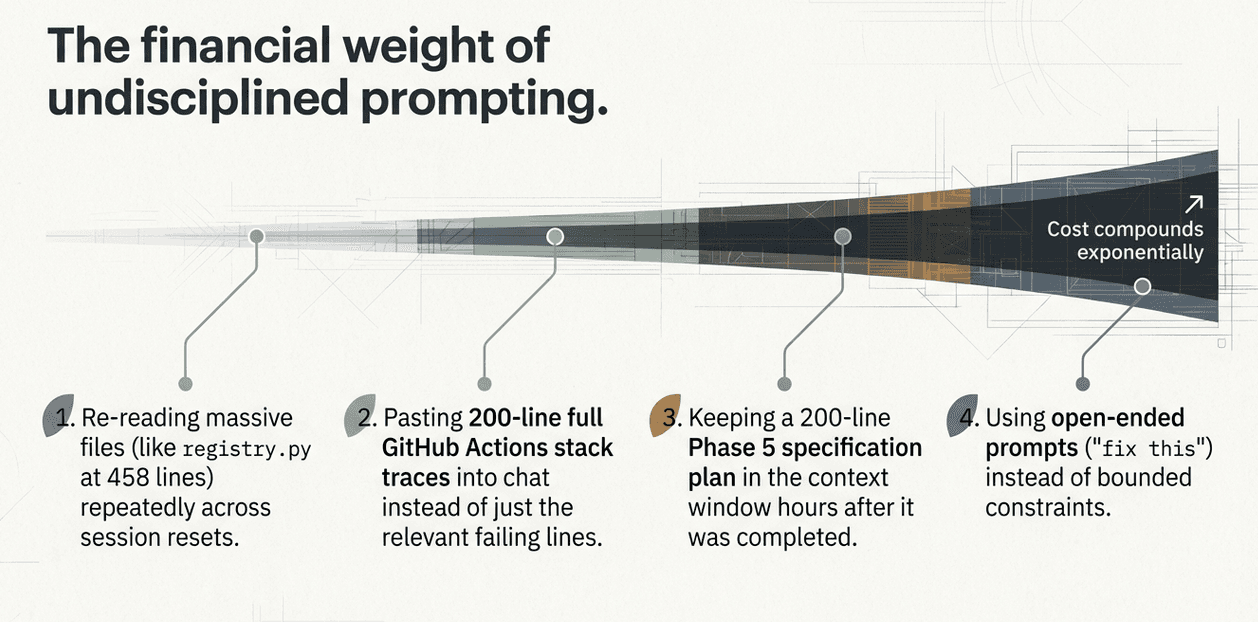
1. Re-reading the same files across phases (cache write waste)
main.py (450 lines), schema.py, recorder.py, registry.py (458 lines) were
read multiple times: once for context, again after a session reset, again when
debugging a related issue. Each new session starts with a cold cache. Prior cache
writes from the previous session are worthless. Every file re-read in a new session
is a fresh cache write billed at $3.75/M tokens.
2. The mkdocstrings investigation
Finding the two-cause root of the RestApiReader could not be found error required
testing multiple hypotheses. Each hypothesis involved reading files, generating a fix,
and discovering it was incomplete. Three rounds before both causes (lazy imports +
missing __init__.py) were identified. This generated output tokens for two wrong
fixes and one correct one, plus the accumulated cache re-reads between each attempt.
3. The Kaggle example rewrites
The wrong LineageRecorder API example was written, deployed to the user, tested,
found broken, explained back, and rewritten. Output tokens paid twice for the same
functionality. Then the MODEL: "titanic_etl" enum error. Then the os.listdir
directory error. Three separate Kaggle errors, each requiring a correction cycle.
4. Long error logs pasted into chat
When CI failed, full stack traces and GitHub Actions logs were pasted into the conversation. Each paste added thousands of tokens to the running context, which then got re-sent as cache reads on every subsequent turn for the rest of the session. The agent only needed the last five lines of most of those errors.
5. The plan file carried everywhere
The Phase 5 model registry plan was a detailed ~200-line specification that sat in the context for the entire implementation session. After the first two phases of implementation it was no longer being referenced, but it was still being cache-read on every turn.
What could have been improved, agent side#
Pre-check APIs before writing examples.
Before writing Kaggle example code for LineageRecorder, the agent should have
re-read the actual class definition. It had read it earlier in the session, but
relied on memory across many intervening turns. The cost of one Read tool call
(cheap) is far lower than the cost of a wrong example, a user debugging it, an
explanation, and a rewrite.
Warn when context is ballooning. By turn 600, the session was carrying the weight of 500 previous turns. The agent could have flagged: "This session is getting large, consider starting a fresh session for the next phase to reduce cache costs." It didn't. The human had no visibility into this.
Consolidate file reads. Multiple files were read one at a time in separate tool calls when they could have been batched. Each sequential read adds to the context before the next one is needed. Reading 5 related files in parallel takes the same context space but doesn't inflate the turn count.
Proactively surface related issues.
When fixing the HTTPBasicAuth lazy import, the agent could have predicted:
"This same pattern exists in rest_api_writer.py, want me to fix both now?"
Instead, the writer file surfaced as a separate ruff error in the next CI run,
another correction cycle, more turns, more cache.
What could have been improved, human side#
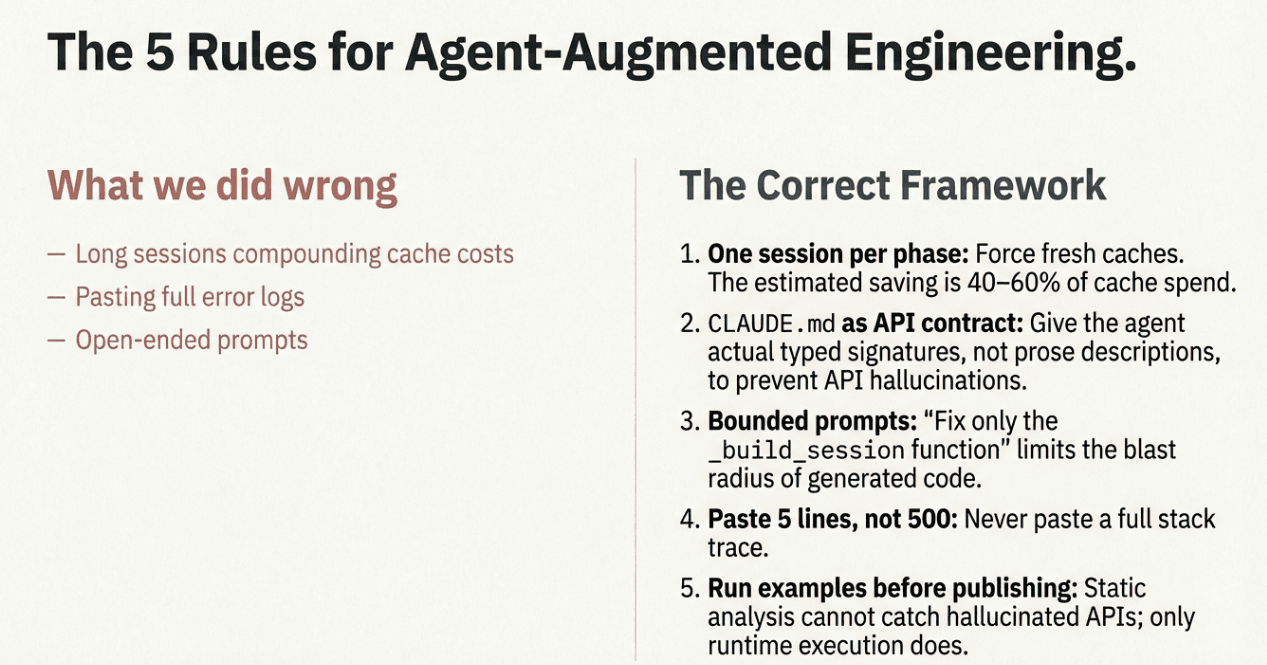
Break work into smaller sessions by phase. One session per phase would have kept each session's cache footprint small. By doing everything in one long session, the later phases were paying the cache cost of all earlier phases on every single turn. Session hygiene is a real cost lever.
Use CLAUDE.md more aggressively.
The project's CLAUDE.md exists. It could have contained the key API contracts:
LineageRecorder constructor signature, ModelRegistry.get_model() return type,
the MODEL enum values. If those facts were in CLAUDE.md, the agent reads
them at session start and doesn't hallucinate simpler versions three hours later.
Don't paste full error logs. Paste the relevant five lines, not the full 200-line stack trace. The agent reads the relevant part and the rest sits in context for hundreds of turns costing money.
Start new sessions when a phase is done. The instinct is to keep going while momentum is there. The cost is that every subsequent turn carries the entire previous phase as dead weight. The disciplined move is: phase complete, new session, fresh cache.
Tighter prompts.
Several prompts were open-ended, like "fix this" and "add examples". Open-ended
prompts invite open-ended responses. Longer responses. More output tokens. More
to review. More cache written. Specific prompts get specific responses.
"Fix only the _build_session function to use a lazy import" costs less than
"fix the import issue" and produces less to review.
A Framework for Collaborative Agent Development#
This is not a section about Ubunye Engine. It's about what building it taught me about how to work with AI agents effectively, stated simply, so it's actually useful.
Five things that work:
1. One session per phase, always. When a phase is complete, start a new session. The cache footprint stays small. Every turn in a new session costs less because it carries less history. The discipline is counterintuitive (you want to keep going while momentum is there), but the cost difference is measurable. Estimate: 40-60% reduction in cache spend with strict session boundaries.
2. CLAUDE.md as a living API contract.
Any interface the agent will need to call or reference should be in CLAUDE.md
with its actual signature, not prose description. Not "the LineageRecorder
records task runs", but the actual constructor and method signatures, typed.
The agent reads CLAUDE.md at session start. If the API is there, it won't
invent a cleaner-sounding version three hours later.
3. Bounded prompts, not open-ended ones.
"Fix the import issue in rest_api.py" generates a targeted response.
"Fix the import issue" generates a response that may touch three files you
didn't ask about and add error handling you didn't need. Scope in the prompt
produces scope in the output. Scope in the output reduces review time.
4. Paste five lines, not five hundred. When something breaks, find the relevant line of the error and share that. Full stack traces and full GitHub Actions logs paste thousands of tokens into the context, which then get re-sent as cache reads on every subsequent turn for the rest of the session. The agent reads the relevant part. The rest is pure cost.
5. Run examples before publishing them. If you ask the agent to write example code, run it before you use it. API hallucinations pass static analysis. They fail at runtime. The ten seconds it takes to run the example is worth less than the debugging round when someone else runs it and finds it broken.
Three things the tools should do better:
Surface context size. By turn 600 of a 1,008-turn session, the cache footprint was enormous. The agent had no way to signal this and didn't. A token budget indicator (visible, real-time, costed) would change how humans manage sessions. This doesn't exist yet in any tool I've used.
Re-verify APIs before writing examples. If the agent is about to write
code that calls an API it read 400 turns ago, it should re-read the source
before writing. The cost of a Read tool call is orders of magnitude less
than the cost of an API hallucination correction cycle. This is a tool design
problem, not a user discipline problem.
Persistent project memory across sessions. The biggest structural weakness
of current AI coding tools is that every session starts from scratch. A human
engineer working continuously for two weeks carries two weeks of context in
their head. The agent starts fresh every morning. CLAUDE.md is a manual
workaround for a problem that should have a first-class solution: structured,
persistent, queryable project memory that the agent can read and write,
survives session boundaries, and gets more useful over time.
The Question This Blog Doesn't Answer (But Should)#
Before getting to the name, there's an honest gap in this entire post worth naming.
Reading it back, it answers how this was built well. It does not answer why you should use it. That's a different question, and the harder one.
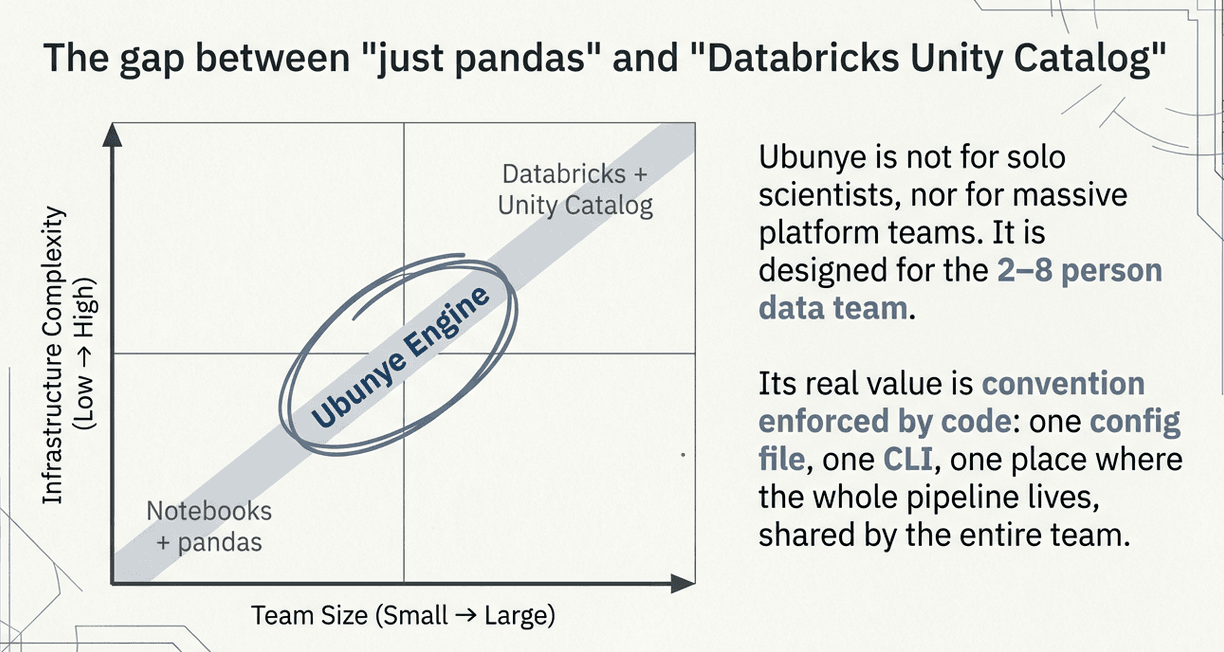
Who is this actually for?
Not a solo data scientist running notebooks. They don't need a framework; they need pandas and a good naming convention. Not a company running Databricks with a dedicated platform team either; they already have Unity Catalog, Delta Live Tables, and MLflow baked in.
The real target is the gap in between: a data team of 2-8 people that has
outgrown notebooks but can't justify a full platform engineering hire. Teams where
the same person writes the ingestion job, trains the model, deploys it to
production, and then gets paged when it breaks at 3am. Teams where "model
versioning" currently means a folder called models_final_v3_USE_THIS_ONE/.
For that team, Ubunye Engine's value proposition is specific:
- You write
transform(). The engine handles I/O, lineage, monitoring, and model versioning around it. - Your notebook code and your production code are the same code. No rewrite when you go from experiment to prod.
- When something breaks,
ubunye lineage traceshows you exactly what data that run saw. No archaeology.
The value is not the code. It's the convention.
This is the thing worth understanding clearly. Every individual component in Ubunye Engine exists elsewhere. Pydantic v2 config exists in a hundred libraries. Lineage tracking exists in MLflow. Model versioning exists in DVC. Spark readers exist in PySpark itself.
The value Ubunye provides is that all of these are wired together the same way
for everyone on your team. When a new engineer joins, there is one right place to
look. The ETL lives in transformations.py. The config lives in config.yaml.
The model artifact is in .ubunye/model_store/{use_case}/{model}/versions/. The
lineage for any run is under .ubunye/lineage/. The CLI has one entry point:
ubunye.
Compare this to the alternative, which every data team knows intimately: every engineer makes different choices. One uses a bash script. One uses a Python file with hardcoded paths. One trains a model in a notebook and pickles it to a shared drive with a name that includes "FINAL". One writes a Spark job that nobody else knows how to run. All of them work. None of them are compatible with each other.
Ubunye's actual value is one convention, enforced by code, shared by the whole team. The framework is an organizational protocol dressed as a Python package. That convention, the agreement about how things are done, is worth more than any individual feature the engine provides, because it's the thing that lets a second engineer pick up where the first one left off.
Why not just use Airflow + MLflow + Delta Lake?
You could. That stack is proven and well-supported. But it also means: three separate tools to learn, three separate configs to maintain, three separate places to look when something breaks, and a minimum infrastructure footprint that requires someone to care for it full-time.
Ubunye Engine is not a replacement for that stack at scale. It is a lower-friction path to getting to scale: one config file, one CLI, one place where the whole pipeline lives.
Whether that trade-off is right depends entirely on your team's size and context. This project doesn't pretend otherwise.
What Ubunye Means#
Ubunye is a Zulu word meaning oneness or unity.
The name was chosen deliberately. The goal was never to add another tool to the stack. It was to unify the stack. One config. One CLI. One lineage record. One model registry. One way to move data from raw to production, regardless of the source system, the ML library, or the cloud provider.
Whether that goal has been achieved is for users to decide.
What This Post Is Actually Trying to Say#
This is the part I want understood clearly. Not the architecture. Not the cost breakdown. This part.
The raw journey format, the specific error messages, the honest retrospective: they all serve one purpose: to show that this project was finished, not just started.
Most open-source projects are abandoned. GitHub's data is consistent on this:
the majority of public repositories have fewer than five commits. Of the projects
that survive past an initial push, most stall at 60-70% complete. The interesting
part is built, the boring work isn't. No tests. No CI. No docs. No example that
anyone actually ran. A README.md that describes what it will do someday.
The frameworks that have this level of completion, the ones with 200+ tests, real documentation, CI matrices, published packages, and end-to-end examples, were built by teams:
- Kedro (QuantumBlack/McKinsey): 15+ engineers, 3 years, millions in organizational backing
- Prefect: 20+ engineers, VC-funded, dedicated docs and devrel teams
- DVC (Data Version Control): Iterative.ai, 30+ engineers
- Great Expectations: 50+ engineers, dedicated quality assurance team
These were all built by teams. This was built by one person in approximately 30 human hours with an AI agent.
That comparison is the one I'm most proud of. Not because solo work is better than team work; it isn't. But because it demonstrates what this specific combination of human judgment and agent capability can produce at a level of completion that was previously reserved for well-funded teams.
Why did I build this particular thing?
Because I've lived the problem it solves. In production data engineering roles,
I've seen the archaeology, the week spent figuring out which version of which
script produced which model. I've seen the models_final_v3_USE_THIS_ONE/ folder.
I've been the person paged at 3am who had to reconstruct what a pipeline did from
git history and intuition because there was no lineage record.
The idea was not "build a framework." The idea was "never do that archaeology again." The framework is the consequence of the constraint.
Is the architecture new?
Partially. The individual components (Pydantic config, Spark I/O, lineage JSON records, model versioning) all exist elsewhere. What's different is the combination and the design principle:
- Kedro has a similar config-driven pipeline approach, but doesn't own the model lifecycle; you integrate MLflow separately.
- MLflow has model registry and versioning, but it's coupled to the MLflow server and doesn't own the data pipeline.
- DVC has data versioning and pipeline tracking, but requires a separate model serving layer.
- Metaflow has a similar decorator-based approach to pipeline definition, but it's AWS-native and doesn't have the config-first philosophy.
The combination that doesn't exist elsewhere: config-driven + library-independent model interface + filesystem-native + single CLI + lineage-by-default. No server required. No cloud account required. Run it locally. Run it on Databricks. Run it on a Raspberry Pi if your data is small enough. The config is the interface; the rest is plugs.
The UbunyeModel hexagonal design (the engine never importing ML libraries)
is the piece I'm most proud of architecturally. It appeared naturally from the
constraint "don't force users to install libraries they don't use," and the
architectural result is something most ML frameworks never achieve: a model layer
that is genuinely backend-agnostic. Swap sklearn for ONNX for a custom C++ model
without touching the engine.
That's not done elsewhere in this exact form. And I thought of it not by reading about hexagonal architecture, but by following the constraint. Sometimes the right principle arrives when you're not looking for it.
The discipline that actually matters:
Writing test 251 is not interesting. It is necessary.
Debugging the fetch-depth: 0 CI failure at 11pm is not interesting. It is necessary.
Running your own example code before publishing it is not interesting. It is necessary.
The discipline to ship boring work, the work that most engineers skip because it's not intellectually stimulating, is rarer than the ability to design interesting architecture. And it is worth considerably more, because interesting architecture that isn't tested, documented, or running is just a whiteboard photo.
That's the real message. Not "look at this framework." But:
I am the kind of engineer who finishes things, not just codes things.
The pip install works. The tests pass. The docs are live. The example ran on real data and the errors were fixed before this post was written.
That's not a start. That's the point. And it's rarer than it should be.
One More Thing You Should Know#
This blog was co-written with an AI agent.
That's not a disclaimer. It's the point.
The blog is a document about building software with a human-AI collaborator. The blog itself was built through human-AI collaboration. The agent drafted the structure. I pushed back on the sections that were too clean, too polished, too careful. The agent rewrote them. I pushed back again. The rough edges in this document are the places where I said "no, say it like this", and those are the parts worth reading.
I'm not mentioning this because I have to. I'm mentioning it because not mentioning it would be dishonest. The entire argument of this post is that human-agent collaboration produces something neither could produce alone, a combination of the agent's capacity for volume and consistency and the human's capacity for judgment and authenticity. This post is evidence of that. Hiding the evidence while making the argument would undermine the argument.
There's a version of this blog that a professional editor polished, all rough edges smoothed, all awkward sentences fixed. That version would read better. It would say less.
The version you read is the one where a human who built a framework over 30 hours and R1,520 and hundreds of small decisions sat down and tried to tell the truth about it, with an agent doing the structural work and a human doing the substantive work. That is the collaboration model described above. The blog is a proof of the thesis, not just a description of it.
The Ubunye Engine is open source.
Source code: github.com/ubunye-ai-ecosystems/ubunye_engine
Documentation: ubunye-ai-ecosystems.github.io/ubunye_engine
Install: pip install ubunye-engine