Student success analytics and recommendations at Wits
Using data to help students and a university decide
A university holds a great deal of data about how students are doing. The work was turning it into something faculties and support staff could act on, early enough to matter.
- What it is
- Production system
- Role
- Data Scientist, Business Intelligence Services
- Organisation
- University of the Witwatersrand
- Period
- June 2018 to April 2020
- Status
- Completed
- Built with
- Topics
- Recommender systems
- Decision support systems
- Data science
- AI education
The problem
Business Intelligence Services was the university’s central analytics and reporting capability. It held a lot of institutional data, but the questions that mattered, which students may need support, which interventions help, what academic choices make sense, were hard to answer from reporting alone.
Why it mattered
South African university funding is tied to student progression and completion, so better decisions have both a human and an institutional consequence. Earlier visibility means support can be proactive rather than a response to a failure that has already happened.
The context
A central analytics function serving faculties, schools, planning and student-support staff, many of whom came from traditional institutional-research backgrounds rather than machine learning. Anything built had to be usable and maintainable by them.
What I did
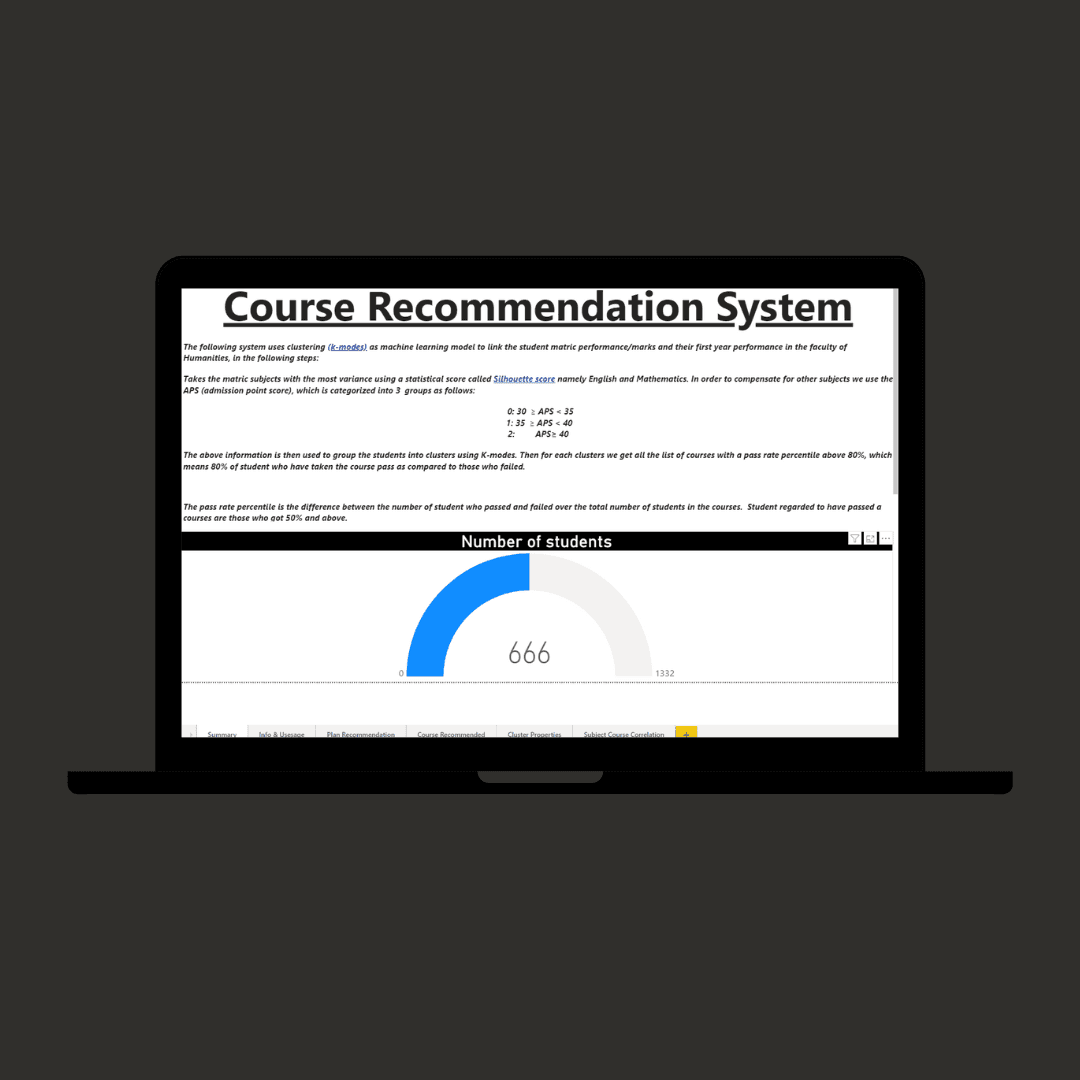
I built analytics, reporting and machine-learning systems for university-wide institutional planning, student success and decision support, using Python, SQL, Power BI and statistical modelling. I developed student recommendation and progression analytics to help faculties and institutional teams see where students needed support, and built a clustering-based recommendation system for the Faculty of Humanities that linked analytical work to student progression and government subsidy outcomes. I also facilitated analytics and machine learning workshops for staff and students, so institutional researchers and analysts could adopt practical modelling in their own work and the capability did not sit with one central team.
What changed
Faculties, schools and planning gained useful information rather than raw institutional data, supporting earlier and better-targeted academic and support decisions. More than R2 million a year in government subsidy impact is attributed to the recommendation initiative.
Who benefited
Students, through better academic decisions and earlier support; faculty and planning staff, through visibility they could act on; and the staff and students trained in the workshops, who kept the skills.
What remained
Analytics and recommendation systems in institutional use, and trained people. This is where a pattern starts that runs through everything since: transfer the capability, do not just deliver the artefact.
Technical context
Python, SQL, clustering and recommendation methods, Power BI reporting and analytics workflows.
Related work
- Shares decision support systems, data scienceDecision support systems for municipalities at the CSIRDjango based predictive analytics and decision support systems serving 17 municipalities, including the City of Cape Town, built at the CSIR.
- Shares decision support systems, pythonGenerator optimisation and streaming at VodacomReal time analytics and optimisation for a national telecoms network: generator dispatch across 15,000+ sites and tens of millions of events a day.
- Shares pythonClimate forecasting and geospatial ML at IBM ResearchApplied ML research at IBM Research: climate forecasting models deployed into IBM PAIRS Geoscope, published work, and a provincial COVID-19 risk dashboard.
- Shares pythonData science platform at a bank: telematics and MLOpsAt Absa Group: architected the data engineering capability data science runs on, with Ubunye Engine at 100M+ events a day for 10+ products.
Related writing
- Shares decision support systemsWe Don't Have Rockets. We Have Towers. A Case for Building Africa's Data CentresGoogle, SpaceX and others are putting computers in orbit because power and cooling on Earth have run out of room. Africa has no space programme, but it has tens of thousands of cell towers that already have power, batteries, cooling, a fence and a link to the network. This post asks whether those towers can be a data centre spread across the land, and answers with the same graph and scoring method I used to send generators to towers during load shedding.
- Shares data scienceBuilding a Data Science Capability From the Ground Up: A Real Life RoadmapTwo years ago I inherited a small data science team with no handover, no documentation, and production models nobody could explain. This is the conversation I wish someone had with me before I started: the challenges, the costs, the thinking behind every move, and the one belief that carried it all. Build systems that outlive the people who built them.
- Shares data scienceThe Modern Data Scientist: A Roadmap for the Age of AI AgentsThe job hasn't disappeared. The mental model has changed. Here's what the roadmap looks like for data scientists and engineers entering (or navigating) the AI agent era, with a South African lens.
- Shares data scienceWhere the Towers Are. A Map of What Africa Already HasPart one argued that Africa's cell towers could be a data centre spread across the land. This part asks the obvious next question: where are they? Using open, crowdsourced data on 565,000 mobile cells, it maps South Africa and the continent, finds that the towers follow the people and the roads, and shows why a map of people and a map of land tell two very different stories.