Part 5 of 6. Previous: Part 4: Making Agents Safe Enough to Act.
Part 4 was about making sure the agent cannot cause harm. This one is about the much more common problem: it does not cause harm, it just ships something wrong.
The sentence I keep coming back to:
Generation gives you code. Feedback loops turn it into engineering.
An agent that writes code and never learns whether it worked is a very fast guesser. Everything below is about closing that gap, and the examples are all real failures from this repository, including one from this week.
The loop, and why every layer exists
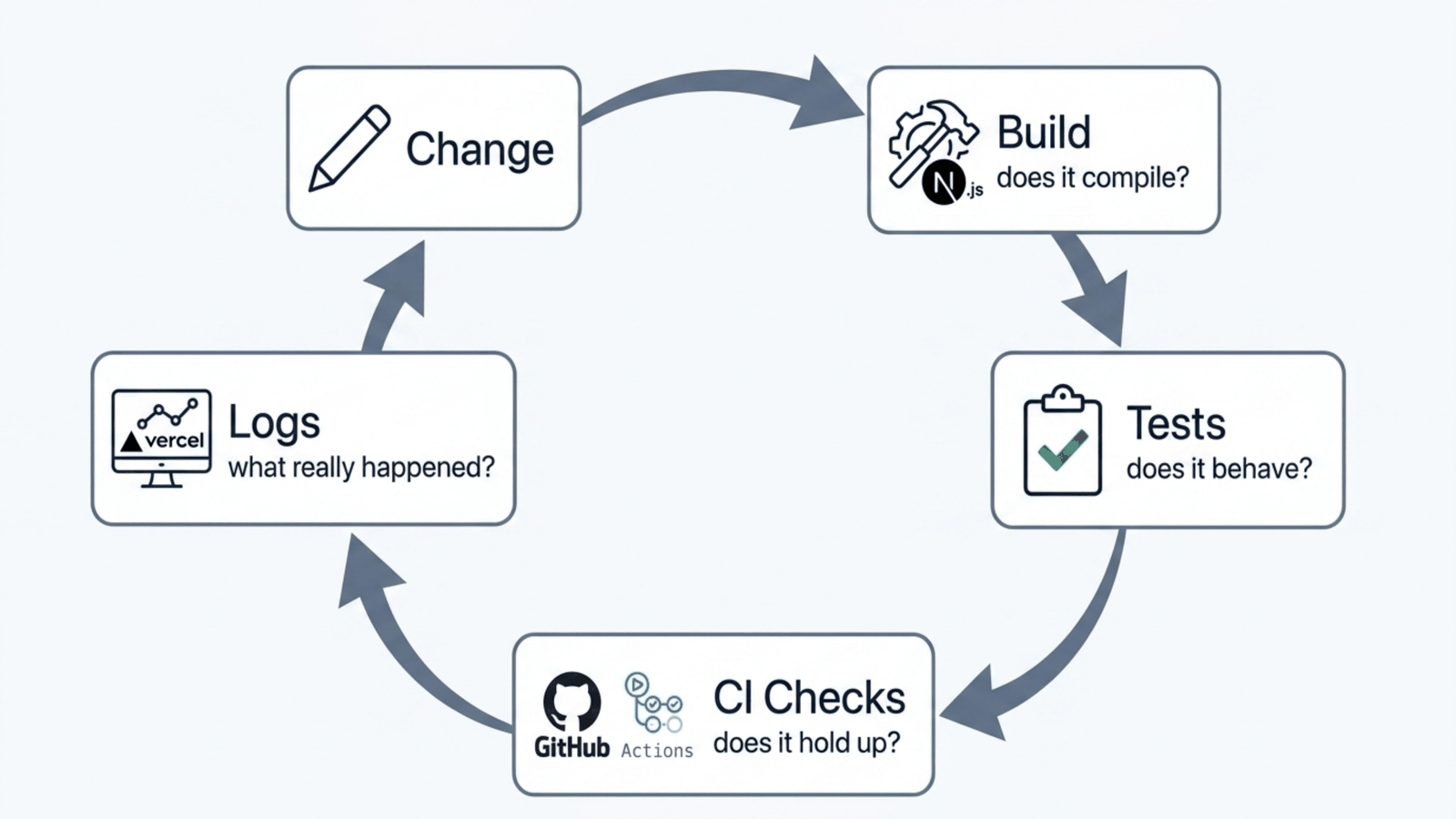
Each layer catches something the one above cannot. A build catches broken syntax and missing imports. Tests catch wrong behaviour in code that compiles fine. Checks in CI catch things that only appear on a real page in a real browser. Logs catch what only happens with real traffic.
And git underneath all of it, which I said in Part 1 is an undo button with a diary. When an agent is moving fast, being able to see exactly what changed between working and broken is most of debugging.
The failure that should change how you think about CI
This is my favourite bug on this site, because it is the one that proves the whole point.
For a long time, every automated check passed. The performance and SEO audit scored a perfect 100 on SEO, on every page, run after run.
Meanwhile every single page on the site was telling search engines it was a duplicate of the homepage, on a domain that was not even production.
The cause was a small inheritance rule. The root layout declared a canonical URL, which is the tag that tells a crawler "this is the real address of this page". The framework merges parent settings into children, so all ten routes inherited the homepage's canonical. On a preview domain.
The audit tool checked that a canonical existed and parsed. It did not check that it pointed anywhere sensible. So the score was 100 and the site was, as far as search engines were concerned, one page repeated ten times on the wrong host.
The same commit that fixed it found something worse. Whole pages were being sent from the server invisible, at zero opacity, waiting for JavaScript to reveal them. Thirty six elements across the site. A crawler that does not run JavaScript saw a blank page. Again, every check was green.
What you can copy: a green pipeline tells you the checks you thought to write are passing. It says nothing about the checks you did not think to write. When your objective becomes "make CI green" rather than "make the thing correct", you have quietly swapped the goal for its shadow.
That fix is now guarded by an actual test. It fetches ten routes and asserts the server HTML contains no content hidden at zero opacity. It also asserts the scroll animations still work, because the obvious fix for the first thing breaks the second, and a test that only guards half of a trade-off invites you to destroy the other half.
The failure I caused this week
Fifteen consecutive red builds. The email said "all jobs have failed". I assumed a performance regression.
It was not. The audit runs against a list of real URLs, and two of them had stopped existing because of content changes I made. One post had been unpublished, so its URL now returned 404. One tag page had been emptied by a change limiting posts to two tags each, so it redirected.
The audit tool treats a 404 as a hard error and aborts the entire run before checking a single budget. Which is why the failure message said nothing whatsoever about performance, and why I spent the first few minutes looking in completely the wrong place.
The investigation is the interesting bit, and it is a shape worth stealing:
   symptom
     "all jobs failed"
   read logs
     a 404, hard error
   which URL?
     the unpublished post
   when?
     last green run was the
     commit before I
     unpublished it
   root cause
     the URL list points at
     content that can retire
Note the "when". Comparing the last good run against the first bad one narrowed a vague failure to an exact commit in about a minute. That is git as a debugging tool, not just a backup.
The fix swapped in URLs that are published and expected to stay that way. But before choosing, I measured. The obvious replacement was my longest article, and it would have been a bad choice: it scores well but its blocking time sits at 240ms against a 300ms ceiling, and the CI machine measures noticeably slower than my laptop. I would have swapped one red build for another. The URLs I picked measure 144ms and 50ms, with real headroom.
What you can copy: when you fix a broken check, verify the fix under the conditions the check actually runs in. Not the conditions that are convenient.
Calibrating against reality, not against your laptop
That lesson had already been learned on this site once, expensively.
One page is a genuine outlier for performance. When the budget was first written, it was set from a local measurement: the page blocked for 433ms on my machine.
On the CI runner, the same commit produced 2151ms, then 649ms, then 676ms.
The first number is a cold machine, which is exactly what taking the median of three runs exists to absorb. But even the median landed around 650ms, far above the local figure. A budget of 433 would have failed constantly for no real reason, and a check that cries wolf gets ignored, at which point you have all the cost and none of the protection.
The ceiling is now 800ms: above the runner's real median with room for a bad day, and still far enough below the broken-page figure that a genuine regression fails.
Two failures that were completely silent
The worst failures do not go red. They report success.
The syndication script did nothing for weeks. It copies posts to another platform. It read its credentials straight from the process environment, but a plain script does not automatically load the local environment file the way the web framework does. So every platform reported "key is not set", the run completed, and the output was indistinguishable from a successful dry run. The credentials had been sitting there the whole time.
Then a worse version of the same thing. One platform threw an error because the account lacked a paid plan. That exception aborted the program before it saved its state file. Which mattered, because by then it had already published to a different platform, irreversibly. The publish happened and nothing recorded it, which is precisely how you end up with duplicates later.
The fix makes each platform fail independently, writes state regardless, and exits non-zero with a summary of what failed.
What you can copy: ask of every automated job, "what does failure look like here?" If the answer is "the same as success", that is the bug, and it is more dangerous than a crash.
When the ground moves underneath you
Two more, quickly, because they are the same lesson.
A commit fixes a wrong model identifier, one incorrect string that made the whole chat feature fail silently. Another moves off a model the provider had retired onto its replacement.
Neither was a coding mistake in the ordinary sense. The first was a typo in a value nothing validates. The second was the outside world changing while the code stood still.
Models are a dependency that expires. Treat them like one.
How a bug becomes something you never repeat
This is the part I care most about, and it is the same idea as the documentation argument in the data science piece: knowledge that lives only in somebody's head is a single point of failure.
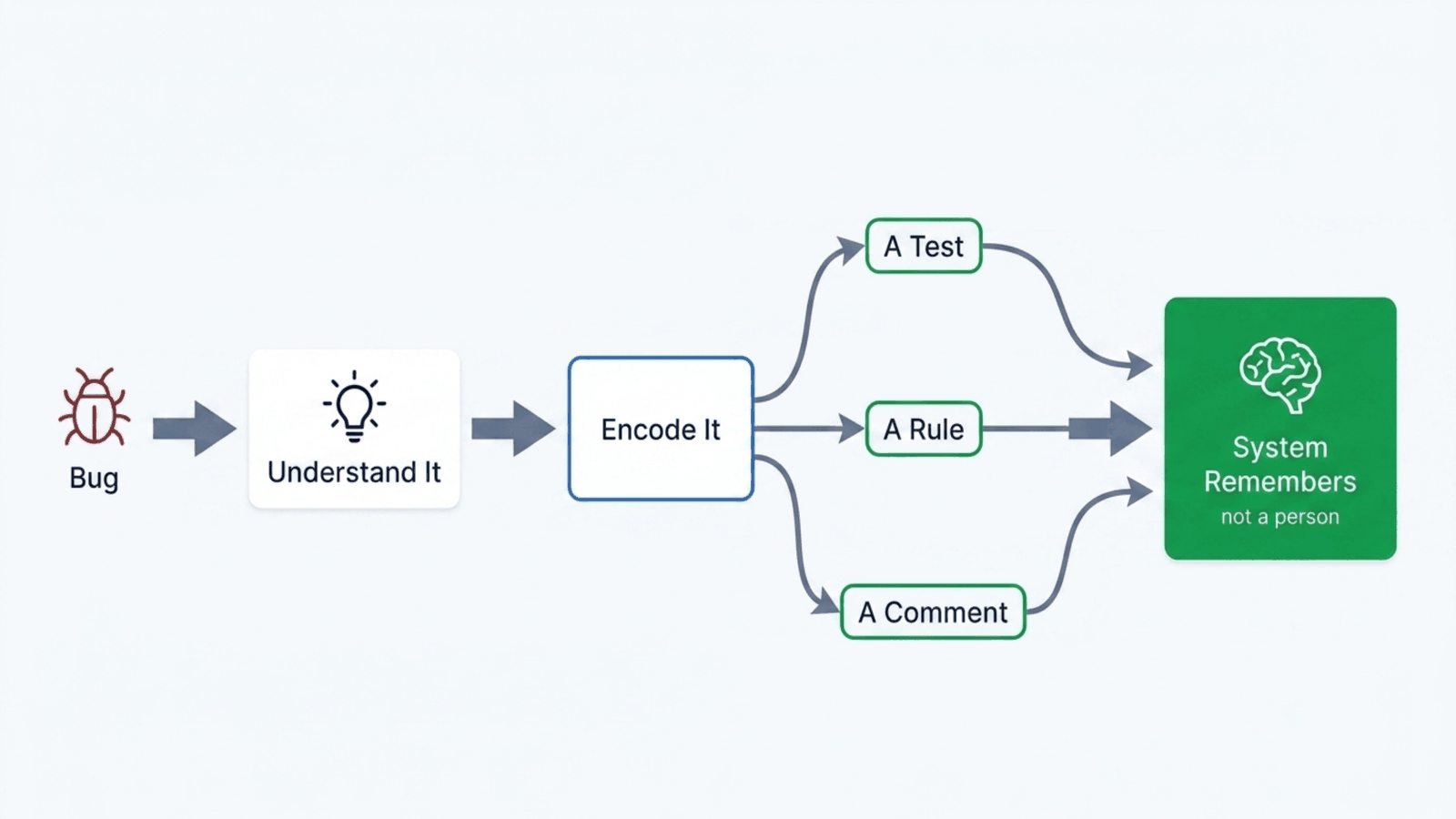
The invisible-content bug became a test that fails if it recurs. The performance budget carries a long comment explaining that the numbers are calibrated on the CI machine, with the three measured figures written down, so the next person does not "helpfully" tighten it back to laptop speed. After this week's failure I added a comment on the URL list saying that retiring content breaks the build here, because that failure is silent in a file nobody thinks to open.
A comment is a weak control compared to a test. But the alternative was nothing, and the reasoning behind a number is exactly what gets lost first.
What you can copy: after you fix something, ask what would have caught it. Then add that. Half the time it is a test. Sometimes it is a permission. Often it is three sentences of explanation next to a number.
What an agent does with all this
Here is why the loop matters more when an agent is doing the typing.
An agent can generate a plausible fix in seconds. Without feedback it will confidently generate the next plausible fix, and the next, and you will not find out which one was right until production does.
With feedback, the agent runs the build and reads the error. Runs the tests and
sees which failed. Reads the CI log and finds ERRORED_DOCUMENT_REQUEST. It is
the same loop from Part 1, just with more layers of truth attached.
The role that leaves for me is not typing. It is deciding what "correct" means, which is precisely what none of these checks can tell you. Every failure above was caught by a check somebody chose to write, or missed because nobody had.
Where this goes next
At this point the agent can act, knows my content, is contained, and can find out when it is wrong. That is a complete working setup, and for most projects it is genuinely where you should stop.
But there is a next step, and it is oversold everywhere. Multiple agents. Loops that run without you. Orchestration. Routing between models.
Some of that is real and useful. Some of it is expensive theatre that turns one clean feedback loop into five noisy ones.
That is Part 6: what these ideas actually mean, what this project does and deliberately does not do, the economics nobody mentions, and where the human still belongs.
Try it yourself
The companion kit has the feedback loop from this post, running for real: a golden set of questions, regression tests that each came from a real bug found while building the kit, and a CI workflow that runs them on every push. It is in the Part 5 folder of the kit, with setup in the kit's README. The checks run on the free mock, so CI costs nothing.
npm run part5:eval
npm test
- Run the eval and read the table. Retrieval is a gate that fails the run; answers are graded and reported.
- Raise the similarity threshold in your settings and watch the gate close, naming exactly which questions stopped finding their notes.
- Break the private notes filter with a one line change and watch the eval and the tests catch it before anything ships.
- Run the eval three times against a small local model. The answers change from run to run and some are wrong while the run still passes, which is this post's point: green only means the checks you wrote passed.
- Add a question of your own to the golden set, or write one for your own notes.
Next: Part 6: From One Agent to an Agentic System. Previous: Part 4: Making Agents Safe Enough to Act.