Part 6 of 6. Previous: Part 5: Making Agents Reliable Enough to Ship.
Five parts in, this site has an agent that can act on real systems, answer from my real writing, is contained by real boundaries, and can find out when it is wrong.
This is the part where people start adding more agents.
I want to be useful rather than fashionable here, so I will do two things. Explain what these ideas actually mean in normal English. And be specific about which of them this project uses, which it does not, and why. Most of this section is honestly in the second category, and I would rather say so than imply an architecture I do not have.
Loops versus workflows
The most important distinction, and the least discussed.
A workflow is a fixed sequence you decided in advance. Step one, then two, then three. Same path every time.
A loop is an agent deciding what to do next based on what just happened. It keeps going until the goal is met or it hits a limit.
WORKFLOW
   step 1
     ↓
   step 2
     ↓
   step 3
     ↓
   done

LOOP
   look at the situation
     ↓
   decide what is next
     ↓
   do it, observe
     ↓
   done? if not, ↺
The trap is assuming the loop is the more advanced option and therefore the better one. It is more flexible and less predictable. Those are the same property.
Use a workflow when you know the steps. Publishing a post is a workflow: build it, check it, deploy it. There is no judgement required, and a fixed sequence is cheaper, faster and easier to debug.
Use a loop when the path depends on what you find. Debugging is a loop, because you cannot write the steps in advance without already knowing the answer.
This site runs both, and neither is exotic. A weekly scheduled job syncs my publications. Another job runs on every push, checking performance and accessibility budgets. Those are workflows, and they are workflows because the steps genuinely are fixed. The loop is me and the agent, debugging together, as in Part 5.
Subagents, and the cost people skip
A subagent is an agent an agent can call, usually with a narrower job and its own fresh context.
The real reason to use one is not division of labour. It is context economy. Remember the desk from Part 1. If the main agent has to read forty files to answer one question, its desk fills with forty files it no longer needs. Hand that to a subagent and only the answer comes back. The search happens somewhere else and you keep your space.
That is a genuinely good reason. Here is the part that gets skipped.
Every subagent is a separate conversation with a separate model call and a separate context to fill. Five subagents is not one task split five ways. It is five tasks, five sets of instructions, five bills.
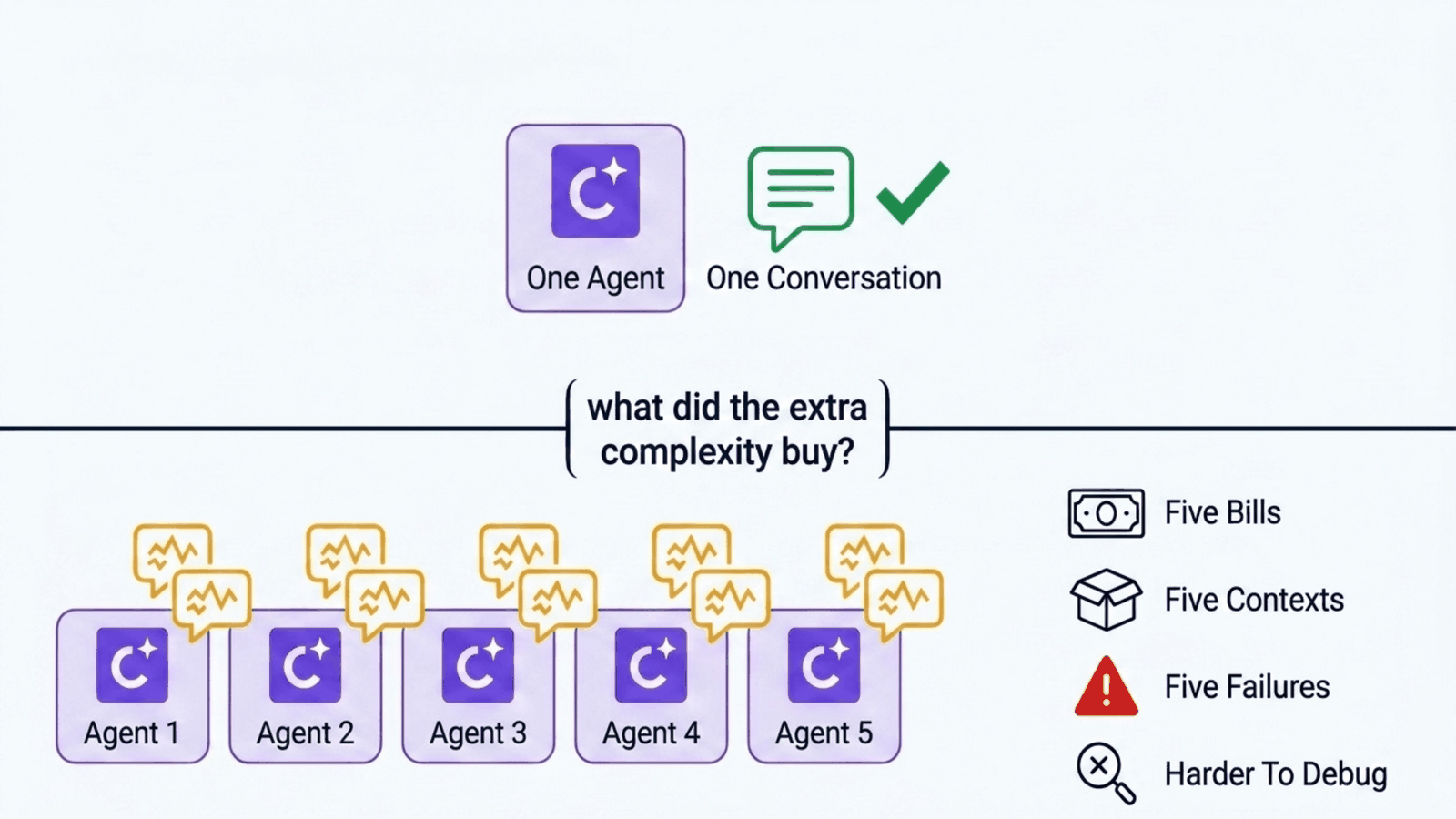
They can run at the same time, which helps wall clock time. They cannot share what they learn unless you build that, and coordinating them is real engineering that you now own.
This project does not use subagents. Not because they are bad, but because I have one repository and one person, and the coordination cost would exceed the benefit. I use them elsewhere, on jobs that genuinely fan out across many files where only the conclusion matters.
Routing, portability and what I actually have
Model routing means choosing between models per request. Cheap fast model for simple things, expensive capable model for hard things.
A gateway sits between your code and the providers, handling routing, fallback when one is down, retries, and usually spend tracking.
Both are real, both are useful at scale, and this site has neither. There is one model, named in one place. No router. No automatic fallback. If the provider has an outage, the chat feature is down until it is not.
What it does have is a thin provider interface, which is a much smaller thing. I use an SDK that presents one shape across providers, and the practical payoff was already described in Part 2: this feature has run on more than one model family, and switching meant changing which provider function was called rather than rewriting the feature.
That is portability, not a gateway. Portability means you can move. A gateway means the system moves for you, automatically, when something breaks. Worth keeping the two words apart, because vendors are highly motivated to blur them.
The economics nobody puts on the slide
Multi-agent architectures are presented as more capable. They are also, always, more expensive along several axes at once.
More calls. Every agent, every step, every retry is a request you pay for.
More tokens. Each agent needs instructions and context. Overlap is duplicated spend.
More latency. Agents that wait on each other add up, and sequential steps are sequential.
More failure surfaces. Five agents and an orchestrator is six things that can fail, plus the coordination between them.
More to debug. In one loop, you read one transcript. In an orchestrated system, you are reconstructing a distributed system from logs, which is a genuine step up in difficulty.
None of that means do not do it. It means a single well designed agent is often the better architecture, and "we added more agents" is not a result. The question is always what the extra complexity bought, measured against what it costs to run and to understand.
I will be honest about a gap here too. This project does not track token spend or cost per feature. There is no dashboard, no per-request accounting. What there is instead is a hard cap: ten messages per visitor per day, twenty per conversation. That bounds the bill without measuring it. It is the right control for a personal site and it would be nowhere near enough for a product.
Deterministic and probabilistic, and where to put the line
This is the idea I would keep if I could keep only one.
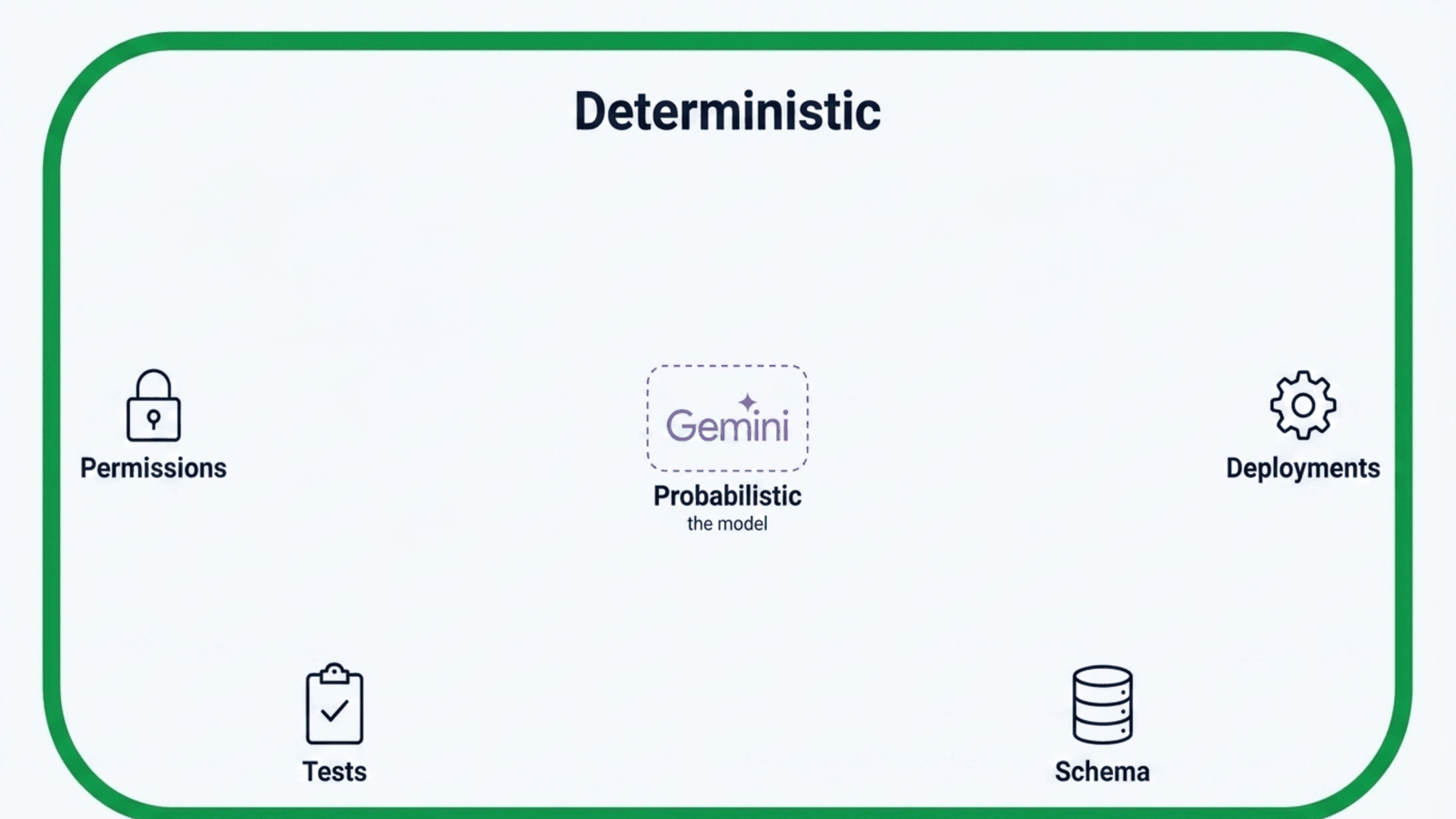
A model is probabilistic. Same input, possibly different output. Usually sensible, occasionally not.
Most of your system should be deterministic. Same input, same output, every time. Databases, permissions, tests, deployments.
Good agentic engineering is mostly about putting the probabilistic part inside a deterministic box.
Everything in this series is an example. The database rules from Part 4 do not care what the model decided. The tests from Part 5 do not care how the code was written. The rate limit does not negotiate. In each case, something that cannot be argued with surrounds something that can.
Two smaller patterns from this site worth copying, both boring on purpose. The reindexing endpoint is idempotent, so running it twice is harmless, which matters when something might retry. And retrieval fails into a static fallback rather than an error, so the assistant degrades to less specific instead of falling over.
Bounded autonomy
Autonomy is not a switch. It is a dial, and it moves per task.
The useful question is not "can the agent do this by itself" but "what does it cost me if it is wrong, and how quickly will I find out?"
Cheap to reverse and fast to detect, like a formatting change caught by a test? Let it run. Expensive and slow to detect, like a schema migration on production data? A human looks first. Not because the agent is untrustworthy, but because that is where the cost of being wrong is concentrated.
That is why the permissions file from Part 2 matters more than any prompt. It is where the dial actually lives.
The progression, and where the human sits
   chat
     ↓ it can act
   agent
     ↓ it knows your work
   + context
     ↓ it reaches systems
   + tools
     ↓ it cannot do damage
   + boundaries
     ↓ it learns it is wrong
   + feedback
     ↓ only if needed
   specialised agents
     ↓ with a clear reason
   orchestrated system
     ↓
   bounded autonomy
Most people jump from the top straight to the bottom. Every step in between is what makes the bottom survivable, and honestly, a lot of good work never needs to leave the middle.
The goal was never to remove the engineer. It is to stop the engineer being the manual execution engine for every step.
What I still own, and own more deliberately than before: the intent, the architecture, the constraints, the permissions, the risk, the evaluation, the trade-offs, and the judgement about what "correct" means. What the agent increasingly owns is the execution.
That is a genuinely better division of labour, and it is uncomfortable at first, because a lot of us built our identity on being the fastest executor in the room.
Where to start
If you have read all six parts and want to actually do this:
Get a coding agent that runs in your terminal rather than a browser tab. Describe what you want, not how to build it. Ask questions instead of giving orders. Build one piece at a time and commit each working piece. Connect one tool, a read-only one, and see what changes. Keep your permissions narrow and boring. Add a test the first time something breaks. And only reach for more agents when you can say out loud what the extra complexity is buying.
You do not need to know the framework. You need to know what you are building, and you need a way to find out when it is wrong.
If you want the argument for why this reshapes the job rather than just the tooling, that is The Modern Data Scientist. This series was the how. That one is the why.
Try it yourself
The companion kit ends here, with the whole assistant: a fixed workflow where code decides the steps and the model makes one call, beside the agent loop from Part 2, both guarded by everything from Parts 3 to 5. It is in the Part 6 folder of the kit, and the kit's README has the setup. Like every stop, it is free to run.
npm run ask -- "Do you deliver to Block L?"
npm run part6
- Ask the finished assistant a question and read the one line cost receipt: one model call, a cited source.
- Run the comparison. The same questions go through the workflow and the agent loop, and the conclusion is computed from your own run. On a small local model the workflow used about three times fewer model calls and tokens.
- Find the question where the loop wins. On one payment question the agent chose better search words than the workflow's fixed step, which is the trade this post describes.
- Ask it to leave a note for the owner. Code drafts it, and nothing is saved until a human says yes.
- Change the write rule in the policy file and run the same request. The code stays the same; only the rules change. That is bounded autonomy.
This is the final part. Start at Part 1: From Chat to Agent. Previous: Part 5: Making Agents Reliable Enough to Ship.